
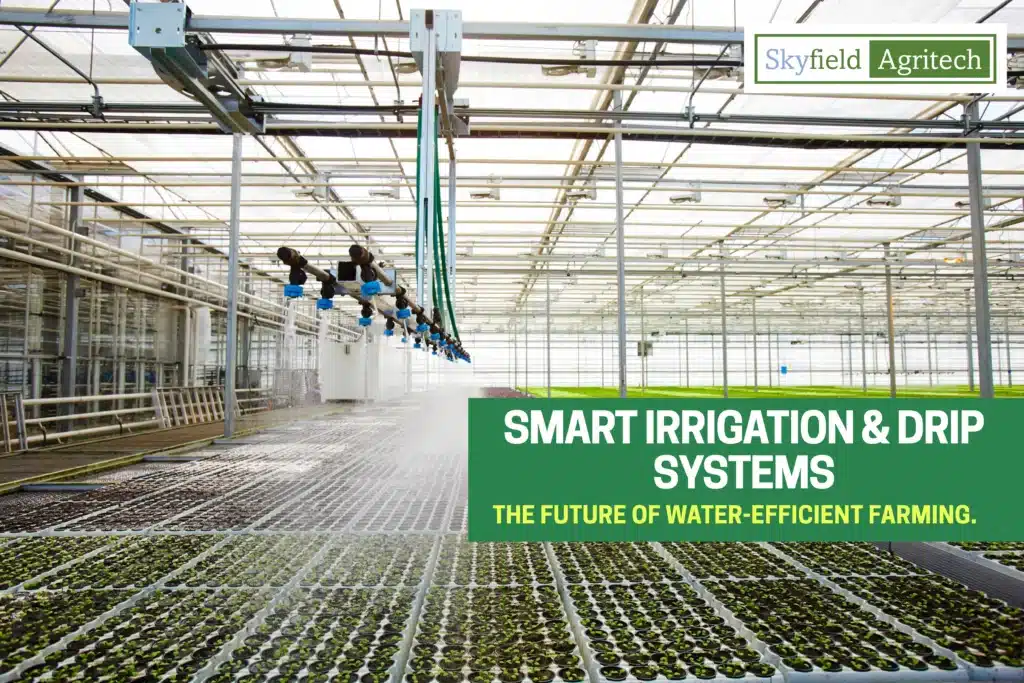
Ever wondered how farmers save water? They grow more with less water. This matters in water-scarce regions. Climate change challenges traditional farming. Population growth increases food demand. Water availability keeps shrinking yearly. Modern farming needs smarter planning. Technology now drives agricultural efficiency. The reason is that the market is currently selling creative watering solutions that can help farmers save water, reduce expenses, and even harvest more. Two such solutions are referred to as smart irrigation and drip irrigation, which are shaping the future of water-efficient and sustainable farming.
Why Water Efficiency Matters in Agriculture?
The freshwater used for agriculture is high in the world. Farmers, even in most parts, continue to use flooding fields or manual watering, which contributes to wastage of water, unequal growth of crops, and soil erosion. The erratic rainfall and disappearing groundwater reserves have made efficient water management a necessity as opposed to an option.
A current irrigation system is concerned with the correct quantity of water at the right moment. These systems do not water the entire field. Instead, they deliver water directly to the roots of plants. This helps plants get exactly what they need to grow. It also saves water and improves plant health and productivity.
Understanding Smart Irrigation Approaches
To get further into details about advanced technologies, it is beneficial to realize what types of irrigation systems are widely used in farming nowadays:
- Surface irrigation, in which water runs over fields.
- Sprinkler irrigation, where water is sprayed in a rainlike fashion.
- Localized irrigation, in which water is sprayed over the roots.
- The use of advanced automated and sensor-based solutions.
These include localized and technology-based systems, which are increasingly becoming popular because they are efficient and sustainable.
What Is Smart Irrigation?
The concept of smart irrigation is the creation of smarter and more precise ideas concerning the topic of watering through the assistance of technology. The systems are founded on sensors, information about weather, indicators of soil moisture, and automatic processes that determine the time and the volume of water crops need.
As an illustration, when the soil is already moist due to rainfall, the system does not water. In case there are high temperatures and evaporation is more, then it changes the set time on its own. This is a data-driven method that will enable farmers not to overwater or underwater their farms, which can be detrimental to crops.
In the long run, farmers who adopt this technology report less water expenditure, improved crops, and improved soil quality. It is the most important as sustainable farming methods are supported, as one of the most precious resources of the planet is conserved.
The Role of Drip Irrigation in Efficient Farming
Drip irrigation is another solution that is strong and is changing agriculture. The method provides water at a low speed and direct rate to the base of the plants through a network of pipes, tubes, and emitters. The water is added as drops on the roots rather than drowning the entire field, and this minimizes evaporation and runoff.
An effective drip irrigation system installed in the right place will ensure that water is evenly distributed, even in areas that are irregular. It works in open meadows, greenhouses, orchards, and other vegetable farms. The other activity farmers can practice is fertilization, where fertilizers are mixed with water, a process which is known as fertilization and which increases the nutrient uptake and reduces the waste generated by the fertilizers.
Discussing the benefits of drip irrigation, it should be said that there is a number of points which should be named:
- Significant water savings
- Less precipitation of weeds owing to watering.
- Better quality and crop yield.
- Lower energy and labor costs
These benefits render drip-based techniques the best in regions where there is a water shortage.
Automation: Reducing Effort and Increasing Accuracy
The farms of the modern world tend to use an automatic irrigation system more and more, which minimizes human error and manual work. Automation enables irrigation programs to operate without human attention, and it saves time for farmers and also gives uniformity.
Programming of these systems can be done depending on the type of crop, the soil condition, and even the seasonal requirements. Others go to the extent of sending alerts to the mobile phones of farmers, making it easy and prompt in the management of farms. Automation not only makes things more efficient but also contributes to precision agriculture, where all the resources are utilized wisely.
Smart Irrigation Meets Drip Technology
The combination of drip-based approaches and so-called smart irrigation is impressive. Sensors measure the moisture of the soil adjacent to the roots of the plants, and automated controls can only allow water to be released when needed. This integration will offer the most favorable environmental conditions to grow and conserve water and energy.
These systems are most handy in dry regions and water-deficient places. This regulation of water usage and management will enable the farmers to grow high-value crops without apprehension.
Beyond Soil: Hydroponics and Advanced Techniques
Water-efficient farming is not necessarily based on traditional soil-based farming, as vertical farming and controlled ecosystems in urban areas are gaining momentum. Farming and controlled ecosystems in urban areas are gaining momentum, particularly hydroponic farming supported by advanced hydroponic irrigation systems. Farming and controlled ecosystems in urban areas are gaining momentum, particularly hydroponic irrigation systems. In hydroponics, plants do not need to grow on soil; the nutrients are absorbed in water.
A popular process in hydroponics is the Nutrient Film Technique NFT. A layer of nutrient-rich water runs constantly over the roots of plants in this process. Due to the reuse and management of water, waste is limited, and efficiency is very high.
These systems show the way of the future farming that will yield more food with less water in fewer areas as compared to traditional agriculture.
Long-Term Impact on Farmers and the Environment
Application of modern irrigation solutions is not only beneficial in the long term but also in terms of saving water. Environmental sustainability is due to healthier soil structures, less chemical runoffs, and lower carbon footprints. Farmers spend less money on inputs, and crop growth becomes more reliable.
As awareness grows, governments and agricultural bodies provide subsidies, training, and technical support to help farmers use these technologies. Such an overall initiative can eventually make the agricultural system of the world more resistant and environmentally friendly.
The Future of Water-Efficient Farming
The future of farming depends on innovation, data, and sustainability. As the pressure on the water resources increases, there is a need to change the traditional practices. Irrigation efficiency technologies prove to be a viable and tested way out.
Applying the concept of drip irrigation, and integrating it with computer-related technologies, farmers will have an opportunity to save their business and protect the environment as well. Even the small-scale farmers can enjoy the development with access to technology, which is increasingly becoming cheaper and widely used.
Conclusion
Water-saving farming does not become a far-fetched dream, but it belongs to reality. The more developed systems, automation, and smart planning are being used to make agriculture sustainable and more productive. Whether it is a sensor, drip irrigation or a soil-less culture, the bottom line is to do more with less.
Such innovations will play an important role in the future generation to ensure that food and water are conserved as the farmers, consumers, and policymakers work together to ensure food security. Smart farming has begun, and the impacts are to be experienced in the coming years.
Also Read : Essential Vertical & Hydroponic Farming Equipment
❓ FAQs
1. Is smart irrigation suitable for small and medium-scale farms?
Yes, smart irrigation systems are scalable and affordable, making them suitable for both small and medium-sized farms.
2. Can smart and drip irrigation systems be added to existing irrigation setups?
Yes, most smart and drip irrigation solutions can be integrated with existing irrigation systems without major changes.
3. How does efficient irrigation reduce long-term farming costs?
Efficient irrigation reduces water, fertilizer, and labor usage, leading to lower operational costs over time.

