
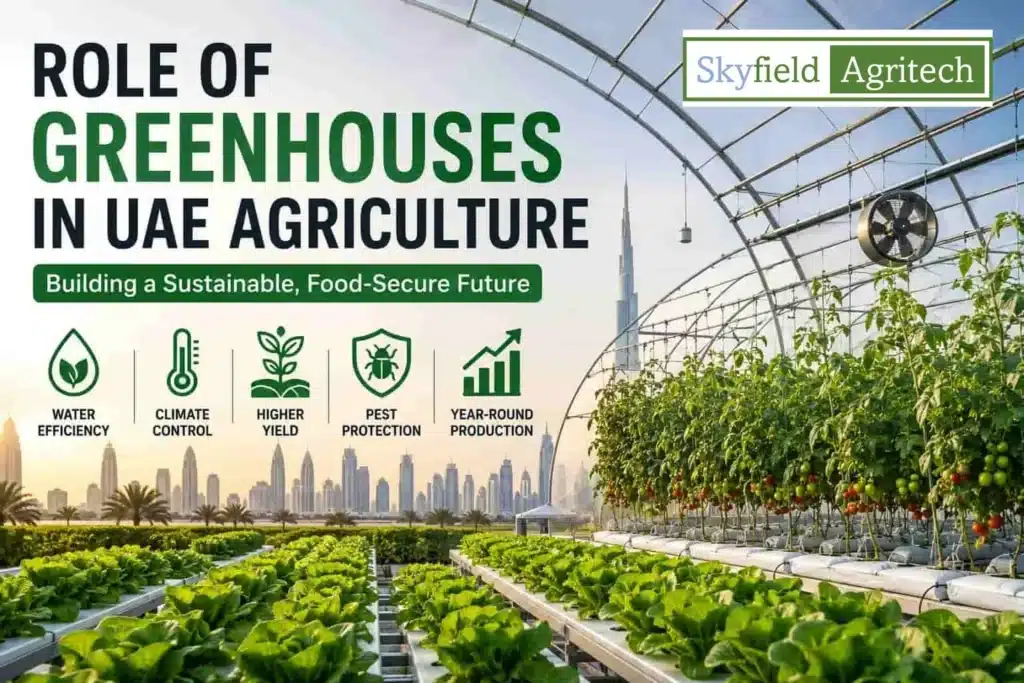
The United Arab Emirates has transformed its agricultural sector by adopting technologies that allow farmers to produce crops despite the country’s hot, dry climate, limited freshwater resources and relatively limited arable land.
Among these technologies, greenhouses play an important role in modern UAE agriculture. They provide farmers with greater control over temperature, humidity, irrigation, pests and growing conditions while helping create a more suitable environment for crops.
The UAE Ministry of Climate Change and Environment identifies the country’s dry climate, high temperatures, limited rainfall and soil constraints as important challenges for agriculture, while also highlighting modern technologies such as soilless farming and other innovative cultivation methods as part of the country’s approach to sustainable agriculture.
But what exactly makes greenhouses so important for farming in the UAE?
Why Are Greenhouses Important for UAE Agriculture?
Traditional open-field farming exposes crops directly to the UAE’s environmental conditions.
During much of the year, farmers have to deal with:
- Extremely high temperatures
- Intense sunlight
- Limited rainfall
- High evaporation
- Water scarcity
- Wind and dust
- Soil limitations
- Pest pressure
- Seasonal changes in growing conditions
A greenhouse creates a protected growing environment that allows farmers to manage many of these variables.
Depending on the greenhouse design, farmers can control or influence:
- Temperature
- Humidity
- Ventilation
- Irrigation
- Fertilization
- Light levels
- Pest exposure
- Air movement
- Growing season
This makes greenhouse farming particularly useful for producing vegetables, herbs, leafy greens and other higher-value crops in challenging climates.
How Do Greenhouses Help UAE Farmers?
1. Protection From Extreme Heat
One of the biggest challenges for agriculture in the UAE is temperature.
Many crops have an optimal temperature range for growth. When temperatures rise significantly above that range, plants can experience heat stress, reduced growth, poor flowering, lower fruit quality and increased water requirements.
A greenhouse does not automatically make the environment cool. Instead, it provides a structure in which environmental conditions can be managed using appropriate technologies.
Commercial greenhouses in the UAE may incorporate systems such as:
- Ventilation
- Evaporative cooling
- Cooling pads
- Fogging or misting
- Shade screens
- Climate sensors
- Automated environmental controls
The exact combination depends on the crop, greenhouse design, location and production objectives.
This ability to manage the growing environment is one of the major reasons protected agriculture is relevant to the UAE.
2. More Efficient Use of Water
Water is one of the most important considerations in UAE agriculture.
Greenhouse production can improve water management by reducing some losses associated with exposed field production and by allowing irrigation to be delivered more precisely.
FAO guidance notes that protected agriculture using greenhouses is particularly suited to dry conditions and can benefit from moisture recycling. It also highlights the potential for higher land and water productivity compared with open cultivation, although actual results vary according to the crop, system and operating conditions.
Modern greenhouse operations can combine the structure with:
- Drip irrigation
- Fertigation
- Automated irrigation
- Moisture sensors
- Water filtration
- Recirculation systems
- Hydroponic systems
This is particularly valuable when greenhouse farming is integrated with hydroponics or other controlled-environment growing systems.
However, water savings should not be treated as a guaranteed percentage. Cooling systems can themselves consume water, and the overall water footprint depends on how the greenhouse is designed and operated. Research conducted under UAE conditions has shown that greenhouse cooling water can materially affect total water productivity.
3. Extending the Growing Season
Outdoor farming is heavily influenced by weather conditions.
A greenhouse gives farmers greater control over when and how crops are produced.
By managing temperature, humidity, irrigation and other environmental variables, farmers may be able to extend production beyond the periods when outdoor conditions are naturally suitable.
This can help businesses:
- Increase annual production
- Maintain more consistent supply
- Plan crop cycles
- Meet contracts with buyers
- Reduce dependence on seasonal production
For commercial agriculture, consistency can be just as important as maximum yield.
4. Better Crop Protection
Greenhouses create a physical barrier between crops and the outside environment.
While greenhouses do not completely eliminate pests or diseases, properly designed structures can reduce exposure and make crop protection easier to manage.
Farmers can use:
- Insect screens
- Sanitation protocols
- Controlled access
- Monitoring systems
- Integrated pest management
- Biological control
- Environmental monitoring
This can be particularly valuable for high-value crops where crop losses can significantly affect profitability.
The UAE has also been developing agricultural monitoring and support programs that consider greenhouse types, irrigation methods and production conditions as part of efforts to improve agricultural planning and sustainability.
5. Higher Production Potential
Greenhouses allow farmers to create growing conditions that are more closely matched to crop requirements.
This can potentially improve:
- Crop growth
- Crop quality
- Production consistency
- Yield per unit of land
- Number of production cycles
FAO notes that protected agriculture can substantially increase land and water productivity under appropriate conditions.
Research involving food crops in the hyper-arid UAE has also found higher greenhouse yields in the studied conditions, although the study showed that total water productivity can change once water used for evaporative cooling is included.
This is an important distinction:
A greenhouse can increase production without automatically making every resource metric better.
The system must be designed and managed properly.
6. Greenhouses Make Hydroponic Farming More Practical
Greenhouses and hydroponics are often discussed separately, but they can work extremely well together.
A greenhouse provides the protected environment, while hydroponics provides the soilless growing system.
For example:
Greenhouse
→ protects the crop
→ manages climate
→ controls environmental exposure
↓
Hydroponic system
→ delivers water
→ delivers nutrients
→ manages the root environment
↓
Automation
→ monitors
→ adjusts
→ records
→ optimizes
This combination is particularly relevant to commercial controlled-environment agriculture in the UAE.
The UAE’s agricultural policy direction increasingly emphasizes modern, climate-smart technologies, including controlled-environment agriculture, hydroponics and vertical farming.
7. Better Use of Limited Agricultural Land
Land availability is another important consideration.
Traditional farming generally requires large horizontal areas of suitable soil.
Greenhouses allow farmers to intensively use available land by optimizing:
- Plant spacing
- Irrigation
- Crop cycles
- Growing systems
- Vertical growing configurations
When greenhouse cultivation is combined with hydroponics or vertical farming, the production density can increase further.
This is one reason controlled-environment agriculture is becoming increasingly relevant to countries with limited agricultural resources.
8. Greenhouses Support Climate-Smart Agriculture
Climate change creates additional uncertainty for agriculture.
Changes in temperature, rainfall and extreme weather can affect crop productivity.
The UAE government has identified climate change, water availability and agricultural productivity as interconnected challenges and has emphasized the use of modern technologies to improve agricultural sustainability.
Greenhouses can help farmers adapt by allowing more control over the production environment.
However, greenhouse technology should be considered part of a broader agricultural system rather than a standalone solution.
A successful climate-smart greenhouse may need:
- Efficient cooling
- Water-efficient irrigation
- Appropriate greenhouse covering
- Climate sensors
- Automation
- Suitable crop selection
- Energy management
- Pest management
Types of Greenhouses Suitable for UAE Agriculture
There is no single greenhouse design that works for every UAE farm.
The appropriate system depends on factors such as crop type, farm size, location, budget and required level of environmental control.
1. Naturally Ventilated Greenhouses
These rely primarily on natural airflow and ventilation.
They can be suitable for certain crops and seasons but provide less environmental control than fully climate-controlled structures.
2. Fan-and-Pad Greenhouses
These use mechanical ventilation together with evaporative cooling systems.
They can help reduce temperatures during hot conditions and are widely relevant to hot-climate greenhouse production.
3. Climate-Controlled Greenhouses
These use sensors and automated systems to manage multiple environmental parameters.
Depending on the design, these may control:
- Temperature
- Humidity
- Ventilation
- Irrigation
- CO₂
- Shading
- Cooling
4. Hydroponic Greenhouses
These combine greenhouse infrastructure with soilless growing systems.
They can provide precise control over water and nutrient delivery while protecting crops from external environmental conditions.
5. High-Tech Controlled-Environment Greenhouses
These integrate greenhouse structures with advanced automation, sensors, climate control, fertigation and data systems.
They are generally more expensive but can provide much greater environmental control.
Greenhouse Farming vs Open-Field Farming in the UAE
| Factor | Greenhouse Farming | Open-Field Farming |
|---|---|---|
| Temperature control | High to moderate | Very limited |
| Crop protection | Better | Lower |
| Water management | More precise | More exposed to losses |
| Production consistency | Generally higher | More weather-dependent |
| Initial investment | Higher | Lower |
| Technical requirements | Higher | Lower |
| Land productivity | Potentially higher | Depends heavily on land |
| Crop selection | Can be expanded with environmental control | More climate-dependent |
| Automation | High potential | Moderate to high |
| Suitability for sensitive crops | Strong | More limited |
| UAE climate suitability | Strong potential | More challenging for many crops |
The choice ultimately depends on the crop, economics and farm objectives.
The Role of Greenhouse Automation in UAE Agriculture
Modern greenhouse farming is increasingly moving beyond a simple structure covered with plastic or glass.
Automation can turn a greenhouse into a data-driven production system.
Sensors can monitor parameters such as:
- Temperature
- Humidity
- Soil or substrate moisture
- pH
- EC
- Light
- Water levels
Automated systems can then control:
- Irrigation
- Fertigation
- Ventilation
- Cooling
- Shading
- Pumps
- Other environmental systems
This can reduce manual intervention and help farmers respond more quickly to changing conditions.
For large commercial farms, automation can also create valuable production data that can be used to improve future crop cycles.
Greenhouses and Food Security in the UAE
Greenhouse farming is not only about individual farm productivity.
It can also contribute to broader food-security objectives by helping increase local production of selected crops.
The UAE has been actively promoting agricultural innovation and climate-smart farming as part of efforts to build a more resilient and sustainable agricultural sector. In 2025, the national “Plant the Emirates” program and National Agriculture Centre were launched to support agricultural development, sustainable farming and stronger partnerships with the private sector.
In 2026, the UAE also highlighted controlled-environment agriculture, vertical farming and data-driven agriculture as areas of innovation in its international agricultural technology efforts.
Greenhouses therefore form an important part of a broader ecosystem that includes:
Greenhouses + Hydroponics + Vertical Farming + Automation + Smart Irrigation + Climate Technology
Together, these technologies can help make food production more adaptable to UAE conditions.
Are Greenhouses Profitable in the UAE?
A greenhouse can be profitable, but profitability should never be assumed simply because the farm uses modern technology.
The economics depend on:
- Greenhouse size
- Crop selection
- Selling price
- Yield
- Number of crop cycles
- Cooling costs
- Electricity
- Water
- Labour
- Fertilizers
- Seeds
- Maintenance
- Automation
- Initial construction cost
- Distribution
- Market demand
High-tech greenhouses can require significant capital investment and technical expertise. FAO specifically notes that greenhouse production can involve substantial investment and sophisticated knowledge.
For this reason, investors should develop a farm-specific financial model before choosing a greenhouse system.
How to Choose the Right Greenhouse for a UAE Farm?
Before investing in a greenhouse, consider the following:
1. What crop will you grow?
Different crops have different temperature, humidity, light and space requirements.
2. What is your production target?
A small farm supplying local customers may require a very different system from a commercial operation supplying supermarkets.
3. How much environmental control do you need?
Some crops can perform with basic protected cultivation, while others require advanced climate control.
4. What is your water source?
Water quality and availability should be assessed before selecting irrigation and fertigation systems.
5. What are your cooling requirements?
This is particularly important in the UAE because cooling can significantly influence operating costs and water use.
6. Do you need automation?
Automation can improve monitoring and consistency but increases the initial investment.
7. What is the expected ROI?
Calculate both capital expenditure and recurring operating costs before selecting the system.
The Future of Greenhouse Farming in the UAE
The future of greenhouse farming in the UAE is likely to involve greater integration between protected cultivation, hydroponics, automation, data and climate-control technologies.
Instead of simply protecting crops from the weather, next-generation greenhouses can become highly controlled production environments.
Future systems may increasingly combine:
- AI-assisted crop monitoring
- IoT sensors
- Automated fertigation
- Smart irrigation
- Climate-control algorithms
- Remote farm monitoring
- Renewable energy
- Water recycling
- Hydroponic growing systems
- Advanced greenhouse materials
The UAE’s current focus on climate-smart agriculture, water productivity and controlled-environment agriculture suggests that technology will continue to play an important role in developing the country’s agricultural sector.
Conclusion: Why Greenhouses Matter for UAE Agriculture
Greenhouses provide UAE farmers with something that is difficult to achieve through open-field agriculture: greater control over the growing environment.
They can help farmers manage extreme temperatures, improve water and land efficiency, protect crops and create more consistent production conditions.
However, a greenhouse is not automatically a solution to every agricultural challenge.
The most successful systems are designed around the crop, climate, water source, production target, technology requirements and business model.
For commercial agriculture in Dubai and across the UAE, the strongest opportunity may come from integrating greenhouse structures with technologies such as hydroponics, smart irrigation, climate control and automation.
The result is a shift from conventional farming toward controlled-environment agriculture designed specifically for the UAE’s climate and resource conditions.
Frequently Asked Questions
Why are greenhouses important in the UAE?
Greenhouses provide a controlled environment that can protect crops from extreme heat and other environmental conditions while allowing farmers to manage irrigation, humidity, ventilation and other growing factors more precisely.
Are greenhouses suitable for Dubai?
Yes. Greenhouses can be particularly useful in Dubai because they allow farmers to create more suitable growing conditions despite the region’s hot and dry climate.
Do greenhouses save water?
They can improve water efficiency through controlled irrigation and moisture management. However, total water consumption depends on greenhouse design, crop requirements and cooling technology. Cooling systems can themselves require water.
Can hydroponics be used inside a greenhouse?
Yes. Hydroponic systems are commonly integrated with greenhouse production to provide precise water and nutrient delivery while the greenhouse provides environmental protection.
Are greenhouse farms profitable in the UAE?
They can be, but profitability depends on crop choice, yield, selling price, energy, cooling, water, labour, construction costs and other operating expenses. A farm-specific financial analysis is essential.
What is the best greenhouse for the UAE?
There is no single best greenhouse for every farm. The appropriate design depends on crop, farm size, climate-control requirements, budget, water availability and production goals.
