
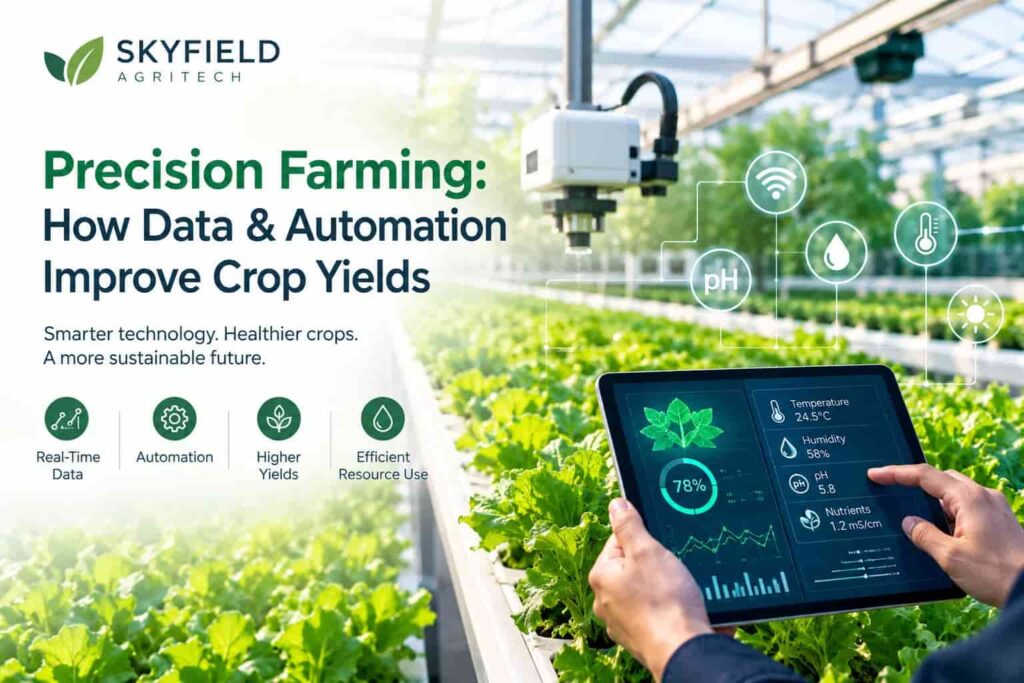
Agriculture is becoming increasingly technology-driven as farmers look for better ways to improve crop yields, reduce resource consumption, and manage farms more efficiently. One of the technologies helping transform modern agriculture is precision farming.
Precision farming uses data, sensors, automation, artificial intelligence, and connected farming systems to help growers make more accurate decisions. Instead of treating an entire farm in the same way, precision agriculture allows farmers to understand the specific needs of different crops, growing areas, and environmental conditions.
For regions such as the UAE, where water availability, high temperatures, and challenging growing conditions can make traditional agriculture difficult, precision farming can play an important role in developing more efficient and sustainable food production systems.
What Is Precision Farming?
Precision farming, also known as precision agriculture, is an approach to farming that uses technology and data to monitor and manage crops more accurately.
Traditional farming often relies on experience and general assumptions when deciding how much water, fertiliser, or other resources crops require. Precision farming takes a more data-driven approach.
Sensors and monitoring systems can collect information about factors such as:
- Soil or growing-medium moisture
- Temperature
- Humidity
- Nutrient levels
- Light intensity
- Crop health
- Water consumption
- Environmental conditions
Farmers can then use this information to make better decisions about irrigation, fertilisation, climate control, and crop management.
This approach can help improve productivity while reducing unnecessary use of water, energy, fertilisers, and other resources.
How Does Precision Farming Work?
Precision farming combines several technologies to create a connected agricultural environment.
1. Sensors Collect Real-Time Data
Sensors are one of the most important components of a precision farming system.
Depending on the farming environment, sensors can monitor temperature, humidity, moisture, light levels, nutrient conditions, and other variables.
The collected information provides growers with a clearer understanding of what is happening inside the growing environment.
For example, if sensors detect that the moisture level has fallen below a specific threshold, an automated irrigation system can respond without requiring someone to manually inspect every growing area.
2. Data Helps Farmers Make Better Decisions
Collecting data is only the first step. The real value comes from using that data to make informed decisions.
Farm management platforms can bring information from multiple sensors and systems together. Growers can then identify changes in environmental conditions and respond accordingly.
Historical data can also help farmers understand patterns over time.
For example, growers may discover that certain crops perform better under specific temperature, humidity, lighting, or irrigation conditions. These insights can then be used to improve future production cycles.
3. Automation Reduces Manual Work
Automation is another major part of precision agriculture.
Instead of manually controlling every aspect of a farm, automated systems can manage repetitive tasks according to predefined conditions.
These may include:
- Irrigation
- Fertiliser delivery
- Ventilation
- Temperature control
- Lighting
- Humidity management
- Nutrient dosing
- Climate control
This can reduce labour requirements and help maintain more consistent growing conditions.
For commercial operations, integrating farm automation systems can make it easier to manage larger growing areas while maintaining greater control over production.
How Precision Farming Improves Crop Yields?
One of the biggest advantages of precision farming is its potential to improve crop productivity.
More Accurate Irrigation
Water is one of the most important resources in agriculture. Applying too little water can stress plants, while excessive irrigation can waste water and create unsuitable growing conditions.
Precision irrigation systems use sensor data and predefined parameters to deliver water when crops need it.
This can help maintain more consistent moisture conditions and reduce unnecessary water consumption.
In water-sensitive regions, technologies such as smart irrigation systems can be particularly valuable for improving resource efficiency.
Better Nutrient Management
Plants require the right balance of nutrients to grow successfully.
Precision farming can help growers monitor nutrient conditions and deliver nutrients according to crop requirements.
Automated dosing systems can provide greater consistency than manual fertilisation, particularly in controlled growing environments.
This can help reduce nutrient waste while ensuring crops receive the resources they need for healthy development.
Improved Environmental Control
Temperature, humidity, carbon dioxide, and light can all influence crop growth.
In controlled environments, precision farming technologies can continuously monitor these conditions and automatically adjust equipment when necessary.
For example, an automated system may activate ventilation when temperatures rise above a predefined level or adjust environmental controls when humidity changes.
This is particularly important in controlled environment agriculture, where maintaining stable growing conditions is central to production.
Early Detection of Crop Problems
Data-driven farming can also help growers identify potential problems earlier.
Changes in environmental readings or crop-monitoring data may indicate that plants are experiencing stress.
Early detection gives farmers an opportunity to investigate and correct the problem before it affects a larger portion of the crop.
This can help reduce crop losses and improve overall production consistency.
Precision Farming and Hydroponics
Precision farming is closely connected with hydroponic agriculture.
Unlike traditional soil-based farming, hydroponic systems provide plants with water and nutrients through a controlled growing system. Because the growing environment can be carefully managed, hydroponics provides an excellent opportunity to use sensors and automation.
Growers can monitor parameters such as:
- Nutrient concentration
- Water temperature
- pH
- Electrical conductivity
- Water levels
- Air temperature
- Humidity
- Lighting
Automated systems can then help maintain these conditions within the desired ranges.
Businesses interested in implementing commercial hydroponic farming systems can combine controlled growing methods with automation and data monitoring to improve operational efficiency.
Precision Farming in Vertical Agriculture
Vertical farming is another area where precision agriculture can provide significant benefits.
In a vertical farm, crops are grown in stacked layers, often within a controlled indoor environment. Managing these systems manually can become complicated as the operation grows.
Precision farming technology can help automate and monitor important growing parameters across multiple levels.
For example, automated systems can control lighting, irrigation, nutrient delivery, temperature, and humidity.
This makes vertical farming systems particularly suitable for technology-driven agricultural operations where consistency and resource efficiency are important.
The Role of AI in Precision Agriculture
Artificial intelligence is increasingly becoming part of modern agricultural technology.
AI systems can analyse large amounts of data collected from sensors, cameras, weather systems, and farm-management platforms.
This data can potentially be used to identify patterns and provide insights into crop performance.
AI-powered agriculture may help growers with tasks such as:
- Crop health monitoring
- Disease detection
- Yield prediction
- Irrigation optimisation
- Resource planning
- Environmental management
- Production forecasting
As agricultural technology develops, combining AI with sensors and automation could make precision farming even more responsive and efficient.
Benefits of Precision Farming
Precision agriculture can provide several benefits for commercial growers.
Reduced Resource Waste
Data-driven systems can help ensure that water, nutrients, energy, and other inputs are applied according to actual requirements.
Increased Productivity
Maintaining more consistent growing conditions can support healthier crops and potentially improve yields.
Lower Labour Requirements
Automation can reduce the need for workers to perform repetitive monitoring and control tasks manually.
Better Farm Management
Centralised data provides growers with greater visibility into farm performance and operating conditions.
Improved Consistency
Automated systems can maintain environmental parameters more consistently than manual processes.
More Sustainable Agriculture
Using resources more efficiently can support more sustainable agricultural production and reduce unnecessary consumption.
Why Precision Farming Matters in the UAE
The UAE presents unique agricultural challenges. High temperatures, limited water resources, and the availability of suitable agricultural land can make conventional farming more difficult.
Technology can help overcome some of these challenges by creating more controlled and resource-efficient growing environments.
Precision farming can be combined with hydroponics, vertical farming, greenhouse technology, and automation to create agricultural systems designed for local environmental conditions.
For commercial growers, integrating greenhouse automation technology can help improve control over temperature, ventilation, irrigation, and other important growing conditions.
This makes technology-driven agriculture particularly relevant to the future of food production in the UAE.
Precision Farming vs Traditional Farming
The biggest difference between precision and traditional farming is the way decisions are made.
Traditional farming may depend heavily on manual observation, historical experience, and general application rates.
Precision farming uses real-time information and technology to make decisions more specific to crop requirements.
For example, instead of irrigating an entire growing area according to a fixed schedule, a precision system can use sensor readings and environmental conditions to determine when irrigation is required.
This shift from fixed processes to data-driven management can help farms become more efficient and responsive.
What Is the Future of Precision Farming?
The future of agriculture is likely to become increasingly connected.
Sensors, automation, AI, robotics, cloud-based farm management platforms, and advanced growing systems are expected to work together to provide farmers with greater control over production.
As the cost and accessibility of agricultural technology improve, precision farming could become increasingly important for both traditional and controlled-environment farms.
The combination of smart farming technology, automation, and data analytics can help growers produce more food while making better use of limited resources.
Conclusion
Precision farming is changing agriculture by replacing many traditional guesswork-based decisions with real-time data and automated control.
From smart irrigation and nutrient management to environmental monitoring and automated farm systems, precision agriculture gives growers greater control over the conditions that influence crop development.
For regions such as the UAE, these technologies can be especially valuable because they can help address challenges related to water availability, climate, land, and resource efficiency.
When combined with hydroponics, vertical farming, greenhouse systems, and controlled environment agriculture, precision farming can provide a powerful foundation for more productive and sustainable commercial agriculture.
As technology continues to advance, data and automation will play an increasingly important role in determining how efficiently we grow food in the future.

