
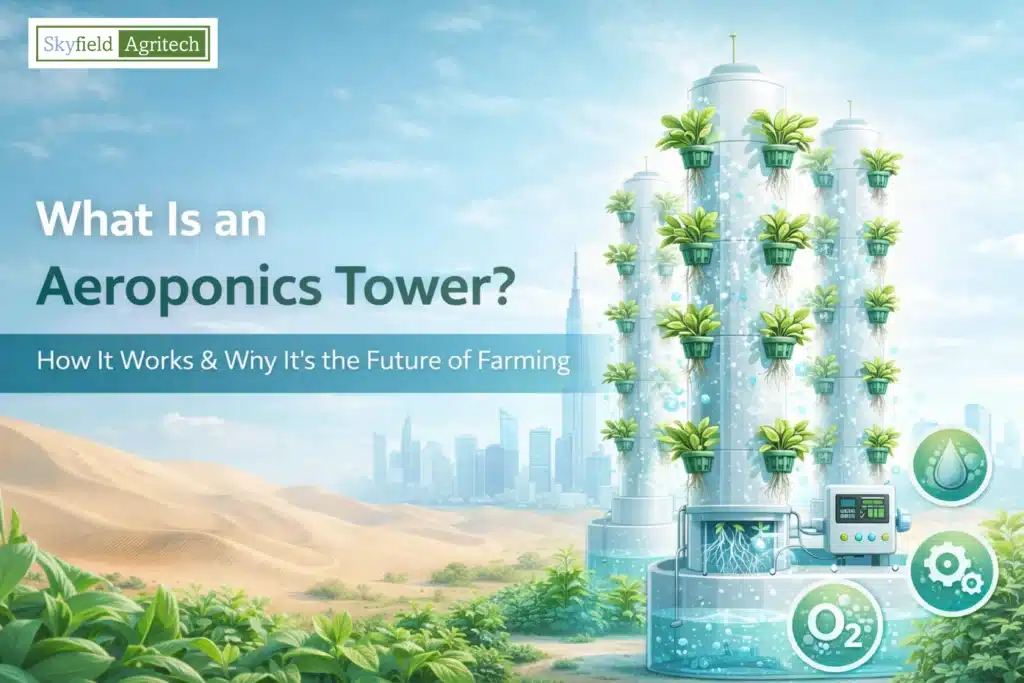
The world’s food production is at a crossroads, with global agriculture bearing the brunt of this change. The increasing human population, decreasing availability of farmable land, effects of climate change, and lack of freshwater are all forcing a rethink of how food is produced. These issues become even more severe in regions like the UAE, where desert conditions, scarce freshwater resources, and harsh climates make conventional agriculture extremely challenging—driving the need for solutions like the Aeroponics Tower. Under such circumstances, implementing a water-efficient farming system is no longer a choice—it has become a necessity.
Consequently, the aeroponics tower stands out as a piece of groundbreaking equipment that can help solve these types of problems. It has been created for rearing plants with the least amount of water, no use of soil, and the maximum utilization of vertical space; thus, aeroponics towers are a step forward in the sustainable agricultural industry. They make it possible to grow fresh produce in an area with a limited supply of water, consistently, and very productively.
This post discusses the conceptualization of an aeroponics tower, its operational mechanism, its comparison with a traditional vertical farming system, and the main reasons that make this technology a global trend in food production.
What Is an Aeroponics Tower?
An aeroponics tower is a vertical growing architectural element where plants are grown without soil. In this case, the plant roots are hanging in the air and get sprayed with a nutrient-rich solution from time to time. This newly discovered technology helps plants evenly receive nutrients and oxygen, maybe even better than in traditional soil systems.
This technology is mostly called tower farming, as it is a space-saving technique of using vertical space whereby plants are stacked up instead of being spread out on the ground. A single plant tower can hold up to hundreds of plants and thus becomes an extremely efficient way of growing plants in small spaces.
Since aeroponics towers do not use any soil, they are advanced soil-less farming technologies. Such systems can be great for indoor farms, greenhouses, rooftops, or any kind of urban agriculture, thus providing the benefits of traditional farming plus more.
How an Aeroponics Tower Works
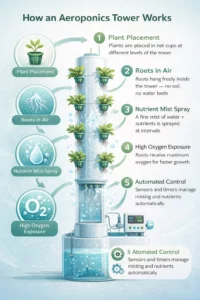
An aeroponics tower basically works through a very carefully designed aeroponics farming system that keeps it very efficient and consistent. The entire process can be summarized in these easy steps.
- Air root cells: Plants are put into net cups or grow ports, and their roots stay inside the tower completely free.
- Spray with nutrient-rich mist: The roots receive a spray of very fine mist having water and nutrients at regularly scheduled times.
- Lots of oxygen: Since the roots are not dipped in water or soil, they get a lot of oxygen, which is very beneficial for their growth.
- Automated cycles: Mist timings, nutrient concentration, and water usage are regulated through sensors and timing devices without the need for any human intervention.
Being a kind of indoor aeroponics system, all the work is done in a controlled environment. Through this setup, the chance of human error is drastically reduced, plant health is optimized, and resource consumption is lowered to a great extent.
Aeroponics Tower vs Traditional Vertical Farming
A lot of people got the two confused—the usage of aeroponics and vertical farming. Actually, they are different.
- Vertical farming is a term that describes the method of physical layout of food production—growing plants in a series of stacked layers.
- Aeroponics refers to the way of plant growing—using mist instead of soil or water beds.
An aeroponics tower grasps both ideas and therefore, is a very efficient tower-based farming system.
Comparison Overview:
|
Feature |
Traditional Vertical Farming | Aeroponics Tower |
|---|---|---|
| Growing medium | Soil or hydroponic water | Air + nutrient mist |
| Water usage | Moderate | Very low |
| Oxygen to roots | Limited | Very high |
| Growth speed | Moderate | Faster |
| System efficiency | High |
Extremely high |
This fusion of vertical farming design and advanced aeroponics technology is what makes aeroponics towers uniquely effective.
Key Benefits of Aeroponics Tower Farming
The advantages of aeroponics towers are substantial in different areas, such as environment-friendly, yield, and cost-effectiveness.
1. Exceptional Water Savings
As a result of aeroponics towers, water usage can be cut down as much as 90–95%; thus, they are among the highly effective water-efficient farming systems available today.
2. No Soil-Borne Diseases
Being a soil-less farming method, aeroponics thus provides the solution for the soil infected pests and pathogens.
3. Faster Growth & Higher Yields
By increasing oxygen levels and providing exact nutrients, plants mature at a faster rate.
4. Minimal Nutrient Waste
Retained nutrients are gathered and reused, limiting the harm to the environment.
5. Reduced Land Footprint
Tower agriculture could be referred to as a method whereby, in a small space, a high number of plants can be produced, which is very suitable for cities and deserts.
When considered together, these positives make the use of aeroponics towers an effective switch to eco-friendly farming.
Indoor Aeroponics Systems for Year-Round Production
By installing an indoor aeroponics system, food can be grown no matter what the weather is like outside. Farmers can control temperature, humidity, CO₂ levels, and light can control grow plants. As a result, the plants get ideal growing conditions perpetually.
They are a lifesaver for areas where people have to deal with unbearably hot weather or is land is scarce. With indoor aeroponics systems, one can:
- Ensure continuous harvests
- Be guarded against climate stress
- Rely less on seasonal imports
Indoor aeroponics serves as a backbone for the food resilience of urban areas and desert countries.
Why Aeroponics Towers Are the Future of Farming
Agriculture of the future needs to focus on sustainability, the potential to scale, and keeping the amount of resources used to a minimum. One of the key reasons why an aeroponics tower is such a great fit is that it is aligned with these goals.
In the situation of growing populations in cities, it becomes necessary to produce food closer to where the consumers are. Aeroponics towers would, therefore, help in local farming besides drastically cutting water usage—this is a crucial requirement of a water-efficient farming system in areas where water is a limited resource.
Another good reason for aeroponics systems being the best solution is that they are modular and scalable. There is no need for more land when a small farm chooses to expand vertically. This feature makes aeroponics towers commercial vertical farming profitability, smart cities, and national food security strategies.
Applications of Aeroponics Tower Systems
By utilizing aeroponics, a tower-based farming system can be implemented in various industries:
- Commercial farms cultivating leafy greens and herbs
- Greenhouses that aim to increase their yields
- Urban and indoor farms in metropolitan areas
- Restaurants and hotels producing their own fresh food
- Smart cities employing sustainable food systems
- Educational and research institutions are experimenting with crop performance
This flexibility is one more thing that makes aeroponics towers very essential tools of modern farming.
Conclusion: Building Smarter, Sustainable Farms
The aeroponics tower is basically revolutionizing the way we produce food because it is fusing technology, green energy, and sustainability. The concept is that it practically uses no water, it doesn’t require any soil, and it only occupies vertical space, therefore, making it viable to solve most of the problems that today’s agriculture worldwide is facing.
Whether it is about being resistant to the climate or ensuring food security in urban areas, aeroponics towers are at th
e crossroads of technology and necessity. With the advancement of agriculture, those who will be first in integrating intelligent systems like aeroponics will become the leaders who will pave the path to a sustainable and food-secure future.
The future of farming is not horizontal—it’s vertical, intelligent, and aeroponic.
FAQ
Q1. How much water does an aeroponics tower use?
Aeroponics towers use up to 90–95% less water compared to traditional soil-based farming.
Q2. What crops can be grown in an aeroponics tower?
Leafy greens, herbs, and compact vegetables grow best in aeroponics tower systems.
Q3. Is an aeroponics tower suitable for hot regions like the UAE?
Yes, aeroponics towers are ideal for hot, water-scarce regions when used in controlled indoor or greenhouse environments.
