
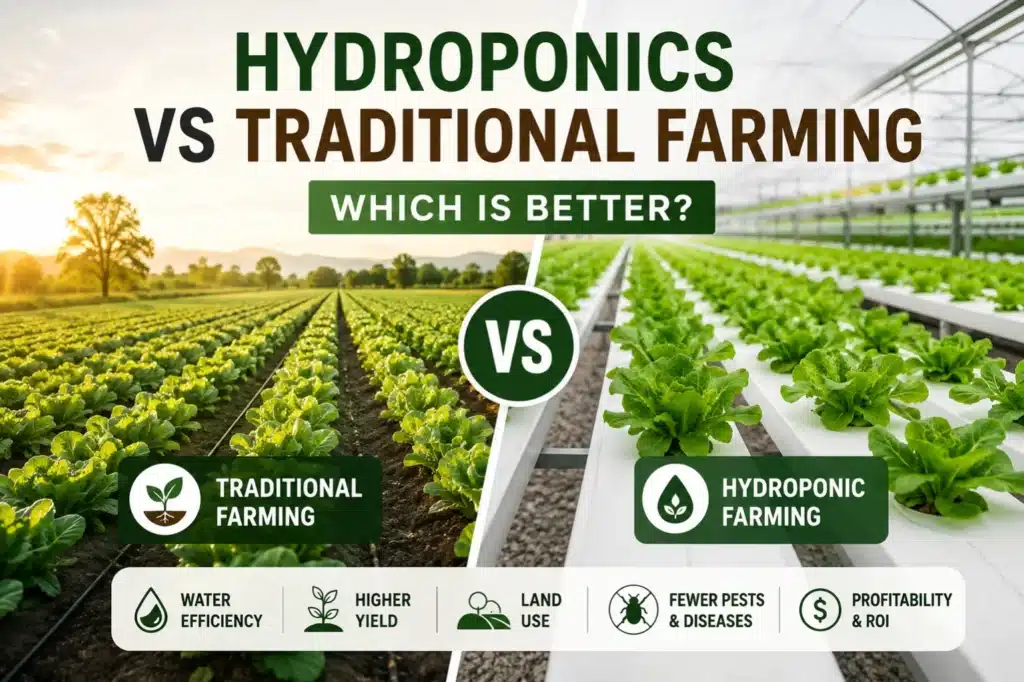
When comparing hydroponics with traditional farming, there is no single answer that works for every farmer, crop, climate, or budget.
Traditional farming has been used for centuries and remains one of the most practical ways to produce crops at large scale. Hydroponics, on the other hand, offers a controlled, soilless approach that can use land and water more efficiently and can be particularly attractive in regions with limited arable land or challenging climates.
For a country such as the UAE, and especially for commercial agriculture in Dubai, the comparison becomes even more relevant. Hydroponic systems can address some of the challenges associated with water availability, soil conditions and extreme temperatures, although they also require higher investment, technical expertise and reliable infrastructure.
So, which is better: hydroponics or traditional farming?
The answer depends on what you are trying to optimize—water, land, productivity, investment, operating costs, crop variety, or long-term scalability.
What Is Hydroponic Farming?
Hydroponic farming is a method of growing plants without traditional agricultural soil. Instead, plants receive water and dissolved nutrients through a carefully managed growing system. Depending on the system, roots may grow directly in nutrient-rich water or in an inert growing medium.
The Food and Agriculture Organization (FAO) describes hydroponics as growing plants without soil while supplying nutrients through a nutrient solution.
Hydroponic systems can be used in greenhouses, indoor farms and vertical farms. Because the growing environment can be controlled, farmers can manage factors such as:
- Water delivery
- Nutrient concentration
- pH
- Temperature
- Humidity
- Lighting
- Root-zone conditions
- Irrigation frequency
This level of control is one of the biggest differences between hydroponic and traditional farming.
What Is Traditional Farming?
Traditional farming generally refers to soil-based agriculture, where crops are planted directly in the ground or in soil-filled growing beds.
Plants obtain water and nutrients from the soil, while farmers manage factors such as:
- Irrigation
- Fertilization
- Soil fertility
- Pest management
- Weed control
- Crop rotation
- Planting and harvesting schedules
Traditional farming can be highly effective when suitable land, soil, water and climate conditions are available.
However, soil quality, water availability, weather and pests can significantly affect crop performance.
Hydroponics vs Traditional Farming: At a Glance
| Factor | Hydroponic Farming | Traditional Farming |
|---|---|---|
| Growing medium | Water/inert substrate | Soil |
| Land requirement | Generally lower | Generally higher |
| Water efficiency | High, especially in recirculating systems | Usually lower |
| Nutrient control | Precise | Dependent on soil conditions |
| Climate control | High in protected systems | Limited in open fields |
| Initial investment | Higher | Usually lower |
| Technical expertise | Higher | Moderate, depending on crop/system |
| Soil-related problems | Eliminated | Can be significant |
| Pest and disease management | Different and often more controlled | Can be challenging |
| Energy requirements | Can be high | Generally lower |
| Crop flexibility | Excellent for selected crops | Very broad |
| Scalability | Excellent in controlled environments | Excellent where suitable land is available |
| Suitability for UAE conditions | Strong potential | More challenging in many locations |
1. Water Efficiency
One of the biggest advantages of hydroponics is water management.
In traditional agriculture, irrigation water can be lost through evaporation, runoff and deep percolation. Hydroponic systems can instead deliver water directly to the plant root zone, and recirculating systems can collect and reuse water.
FAO notes that hydroponics can be an input-efficient and water-saving approach, particularly when combined with protected cultivation, although actual savings depend on the system and how it is operated.
This makes hydroponics particularly interesting for water-constrained environments such as the UAE.
However, it is important not to claim that every hydroponic farm automatically uses a fixed percentage less water. Water efficiency depends on:
- System design
- Crop
- Climate
- Recirculation
- Cooling requirements
- Irrigation management
- Water quality
- Farm management
Recent research involving UAE farms also demonstrates that the resource advantages of hydroponic systems can vary by crop and system configuration.
Winner for water efficiency: Hydroponics
2. Land Requirements
Traditional agriculture generally requires significant land because crops are grown horizontally across fields.
Hydroponics can produce more crops within a smaller footprint, particularly when combined with vertical farming.
This doesn’t mean every hydroponic farm requires dramatically less land. A conventional greenhouse hydroponic farm, for example, may still occupy substantial space.
However, hydroponics becomes particularly land-efficient when growing systems are stacked or optimized for high-density production.
This is one reason controlled-environment agriculture is attractive in locations where suitable agricultural land is limited.
Winner for land efficiency: Hydroponics
3. Nutrient Management
In traditional farming, plants obtain nutrients from soil. Farmers need to understand soil fertility and may need to apply fertilizers, compost or other amendments.
Hydroponics provides much more direct control over nutrient delivery.
Farmers can monitor and adjust factors such as:
- pH
- EC
- Nutrient concentration
- Irrigation frequency
- Nutrient solution composition
This precision can help maintain consistent growing conditions.
But it also introduces a new challenge: mistakes can happen quickly.
FAO highlights that hydroponic systems require technical knowledge and careful nutrient management. Problems with nutrient concentration, water quality or equipment can negatively affect crops very quickly.
Winner for nutrient control: Hydroponics
4. Initial Investment
This is where traditional farming often has an advantage.
A basic soil-based farming operation may require:
- Land preparation
- Irrigation
- Seeds
- Fertilizers
- Machinery
- Labour
A commercial hydroponic operation may additionally require:
- Growing channels or containers
- Pumps
- Reservoirs
- Filtration
- Nutrient dosing systems
- Sensors
- Irrigation infrastructure
- Climate control
- Greenhouse or indoor infrastructure
- Automation
As a result, hydroponics can require significantly more capital upfront.
FAO describes hydroponics as a capital- and labour-intensive practice that requires appropriate technical knowledge and experience.
Winner for lower initial investment: Traditional farming
5. Operating Costs
The answer here is more complicated.
Traditional farming may have substantial expenses related to:
- Labour
- Irrigation
- Fertilizers
- Pesticides
- Machinery
- Soil preparation
- Water
- Crop losses
Hydroponic farms can reduce some resource requirements but introduce other expenses, including:
- Electricity
- Pumps
- Nutrients
- Water treatment
- Sensors
- Equipment maintenance
- Climate control
- Technical labour
For indoor farms, electricity and cooling can become particularly important.
Therefore, hydroponics should not automatically be described as cheaper to operate.
The better question is:
Does the additional investment and operating complexity produce enough additional yield, consistency, resource efficiency or market value to justify the cost?
That’s ultimately a farm-specific calculation.
6. Crop Yield and Productivity
Hydroponics can offer highly controlled growing conditions.
Instead of relying entirely on outdoor weather and soil conditions, farmers can manage the root environment and, in protected systems, other environmental variables.
This can potentially improve:
- Growth consistency
- Crop quality
- Production cycles
- Resource efficiency
- Yield per unit of land
However, higher yield is not guaranteed simply because a farm uses hydroponics.
Poor system design, unsuitable crops, nutrient problems, inadequate cooling or incorrect environmental conditions can all reduce productivity.
Research in the UAE has also found that the performance of hydroponic systems can vary according to crop and system configuration, reinforcing the importance of farm-specific design.
Potential productivity advantage: Hydroponics
7. Climate Control
This is particularly important in Dubai.
Traditional open-field agriculture is directly exposed to:
- Extreme heat
- High solar radiation
- Wind
- Humidity changes
- Dust
- Seasonal variations
Hydroponics itself does not automatically solve these problems.
However, when hydroponics is combined with a greenhouse or controlled-environment system, farmers can manage environmental conditions much more precisely.
This is one of the reasons controlled-environment agriculture has potential in arid regions.
Dubai’s large-scale vertical farming operations demonstrate that controlled hydroponic production is already being used commercially in the region. Dubai’s government reported that the Bustanica facility was designed to produce more than 1 million kg of leafy greens annually while using substantially less water than conventional agriculture.
Winner for environmental control: Hydroponics + protected cultivation
8. Pest and Disease Management
Traditional soil farming can face problems involving:
- Soil-borne diseases
- Weeds
- Insects
- Fungal diseases
- Soil degradation
Hydroponics removes many soil-related problems because there is no conventional agricultural soil.
But this does not mean hydroponic farms are pest-free.
Pests and pathogens can still enter through:
- Water
- Seeds
- Equipment
- Workers
- Air
- Plant material
And because plants in a recirculating system can share water, certain problems can potentially spread rapidly.
So hydroponics changes the disease-management challenge rather than eliminating it.
Advantage: Hydroponics, when properly managed
9. Labour and Technical Expertise
Traditional farming requires agricultural knowledge, but hydroponics adds another layer of technical management.
Commercial hydroponic operators may need to understand:
- Nutrient formulation
- pH and EC
- Irrigation
- Pumps
- Filtration
- Sensors
- Automation
- Climate control
- Water quality
- Crop physiology
This means hydroponics may require more specialized technical expertise.
FAO specifically highlights technical knowledge and experience as important requirements for successful hydroponic production.
Winner for simplicity: Traditional farming
10. Which Is More Suitable for Dubai?
This is where the comparison becomes particularly interesting.
Dubai and the wider UAE present several agricultural challenges, including:
- Hot temperatures
- Limited rainfall
- Water constraints
- Soil limitations in many areas
- High cooling requirements
- Limited suitable agricultural land
Research on UAE agriculture has highlighted the importance of water efficiency and controlled-environment agriculture for improving agricultural productivity under local conditions.
Hydroponics can therefore offer important advantages, particularly when integrated with:
Hydroponics + greenhouse + climate control + automation
For certain crops, this combination can provide a much more controlled production environment than open-field farming.
However, that doesn’t mean traditional farming has no role in the UAE.
Different crops, farm sizes, budgets and business models require different approaches.
Hydroponics vs Traditional Farming: Which Is More Profitable?
This is one of the most common questions—and one of the easiest to answer incorrectly.
There is no universal ROI figure for hydroponics.
Profitability depends on:
- Farm size
- Crop selection
- Selling price
- Yield
- Electricity costs
- Labour
- Water costs
- Initial capital investment
- Equipment depreciation
- Cooling requirements
- Packaging
- Distribution
- Market demand
- Crop losses
For example, a hydroponic farm growing a high-value crop for a reliable local market may have a completely different financial model from a large-scale farm producing a low-margin commodity.
Therefore, instead of asking:
“Is hydroponics more profitable?”
A better question is:
“Can the additional productivity and resource efficiency of hydroponics justify its additional capital and operating costs for this particular crop and market?”
That’s the calculation a commercial farmer should make.
When Is Traditional Farming Better?
Traditional farming may be the better choice when:
- Suitable agricultural land is readily available
- Soil quality is good
- Water is reasonably accessible
- The crop performs well in soil
- Capital investment is limited
- The farmer wants a simpler production system
- Energy costs make controlled environments uneconomical
- The local climate is naturally suitable for the crop
For certain crops and regions, there is simply no economic reason to replace traditional agriculture with hydroponics.
When Is Hydroponics Better?
Hydroponics may be the better option when:
- Water efficiency is a priority
- Agricultural land is limited
- Soil quality is poor
- Consistent crop production is important
- Higher production density is required
- Environmental conditions need to be controlled
- The farm is located in a challenging climate
- High-value crops are being produced
- The farmer can justify the additional capital investment
- There is access to technical expertise
These characteristics make hydroponics particularly relevant to commercial controlled-environment agriculture in Dubai and the UAE.
Hydroponics vs Traditional Farming: Final Verdict
So, which is better?
Neither system is universally better.
Traditional farming wins when:
Low complexity + lower initial investment + suitable land + suitable soil and climate are the priorities.
Hydroponics wins when:
Water efficiency + land efficiency + environmental control + consistent production + intensive farming are the priorities.
For Dubai and other arid environments, hydroponics can be particularly attractive because it addresses several of the limitations that make conventional agriculture more challenging.
But successful hydroponic farming requires more than simply replacing soil with water. It requires appropriate system design, crop selection, water management, climate control, technical expertise and a commercially viable market.
The best solution may therefore not be “hydroponics instead of traditional farming.”
It may be choosing the right production system for the right crop, location and business model.
Hydroponics vs Traditional Farming: Quick Summary
| Category | Better Option |
|---|---|
| Water efficiency | Hydroponics |
| Land efficiency | Hydroponics |
| Nutrient control | Hydroponics |
| Environmental control | Hydroponics + protected cultivation |
| Lower startup cost | Traditional farming |
| Simpler operation | Traditional farming |
| Soil-based crops | Traditional farming |
| Intensive vegetable production | Hydroponics |
| Challenging climates | Hydroponics + controlled environment |
| Limited agricultural land | Hydroponics |
| Long-term scalability | Depends on business model |
| Overall suitability for Dubai | Hydroponics has strong potential |
Frequently Asked Questions
Is hydroponic farming better than traditional farming?
Hydroponic farming can be better for water efficiency, land utilization, nutrient control and controlled production. Traditional farming can be better when suitable land and soil are available and lower initial investment and operational simplicity are priorities.
Is hydroponic farming suitable for Dubai?
Yes. Hydroponics has strong potential in Dubai because it can reduce dependence on soil and improve water and environmental management. For commercial operations, hydroponics is often combined with greenhouses, climate control and automation.
Does hydroponics use less water than traditional farming?
Generally, well-designed hydroponic systems can use substantially less irrigation water than conventional soil-based production, particularly when water is recirculated. Actual savings depend on system design, crop, climate and management.
Is hydroponic farming more expensive?
The initial investment is generally higher because commercial systems require specialized equipment, irrigation infrastructure, nutrient management and often protected or controlled environments.
Is hydroponic farming more profitable?
Not necessarily. Profitability depends on crop, yield, market price, energy consumption, labour, water, capital investment and operating costs. A financial model should be developed for the specific farm rather than relying on generic ROI claims.
Can hydroponics replace traditional farming?
No. Hydroponics is better suited to certain crops and production conditions, while traditional agriculture remains highly effective for many crops and environments. The two systems can also coexist as complementary approaches.
