
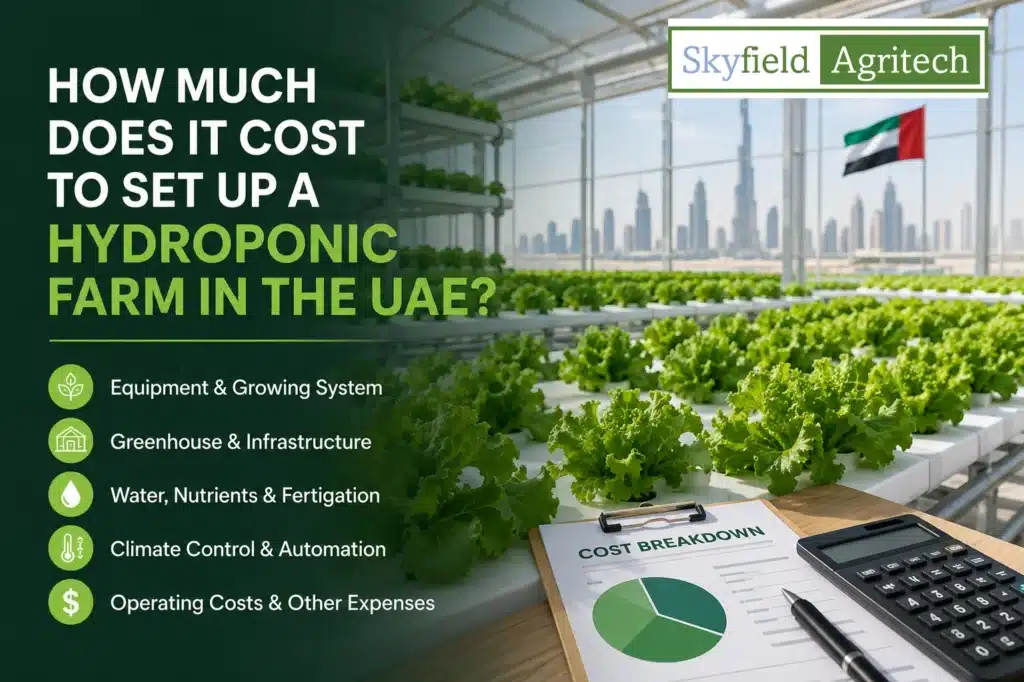
If you are considering starting a hydroponic farm in the UAE, one of the first questions you are likely to ask is: How much does it cost to set up a hydroponic farm?
The honest answer is that there is no single price.
A small hydroponic setup for testing a crop is very different from a commercial greenhouse designed for year-round production. Likewise, an indoor vertical farm with advanced lighting, cooling, automation and environmental controls can require a substantially larger investment.
As a broad planning guide, a small commercial or pilot setup may require tens of thousands of AED, while a properly designed commercial hydroponic farm can move into the hundreds of thousands of AED or more depending on its size and technology. Large, highly automated indoor farms can require significantly greater capital.
The important thing is not to choose a system based on its price alone. The right question is:
- What level of investment is appropriate for the crop, production target, climate and market you are planning to serve?
- What Determines the Cost of a Hydroponic Farm in the UAE?
Several components contribute to the total setup cost.
Two farms with similar growing areas can have very different budgets because their designs, crops and levels of automation may be completely different.
🔹Farm Size and Production Capacity
The first major factor is the size of the farm.
A small pilot farm may need only a basic growing system, irrigation and fertigation equipment, environmental monitoring and a suitable protected structure.
A commercial operation requires much more planning. The system may need multiple growing zones, water treatment, fertigation, climate management, crop handling areas, storage and other infrastructure.
Rather than asking for a cost per square metre alone, it is more useful to determine your expected production volume first and then design the farm around that target.
🔹Greenhouse or Indoor Farm?
Your choice of growing environment can have a major effect on the investment.
A greenhouse hydroponic farm can make use of natural sunlight while providing a controlled growing environment. Depending on the UAE location, crop and greenhouse design, the system may require ventilation, shading, cooling, screens and other climate-management equipment.
An indoor vertical farm, on the other hand, provides a much higher degree of environmental control but generally requires additional infrastructure such as artificial lighting, cooling and environmental control systems.
Neither option is automatically better.
The right choice depends on your crop, available space, production objectives, energy requirements and target market.
🔹Hydroponic Growing System
The hydroponic technology itself is another part of the investment.
Different crops and growing conditions may call for different systems, such as:
- NFT systems
- Drip irrigation and substrate systems
- Deep water culture
- Vertical growing systems
- Aeroponic systems
For example, a system designed for leafy greens may have very different requirements from one designed for vine crops such as tomatoes or cucumbers.
This is why buying a ready-made system before deciding what you want to grow can be a costly mistake.
The crop should influence the system design, rather than the other way around.
🔹Climate Control
Climate control deserves particular attention in the UAE.
A hydroponic system does not remove the challenges associated with the local climate. Temperature, humidity, ventilation and solar radiation can all influence plant growth and production consistency.
Depending on the farm design, the setup may require:
- Ventilation
- Cooling
- Shade screens
- Humidity management
- Temperature monitoring
- Environmental sensors
- Automated climate controls
These systems can increase the initial investment, but they can also be important for maintaining the growing conditions required by the chosen crop.
A greenhouse that is inexpensive to build but poorly suited to the local climate may ultimately cost more through inconsistent production and higher operating problems.
🔹Water Treatment and Fertigation
Hydroponics relies on careful management of water and nutrients.
Commercial farms may therefore require equipment for:
- Water filtration
- Water storage
- pH management
- EC monitoring
- Nutrient dosing
- Fertigation
- Water circulation
- Drainage and recovery
Water quality should ideally be assessed before finalising the system design.
The available water source, its quality and the crop requirements can influence the equipment needed.
🔹Automation
Automation is another variable that can significantly change the project budget.
A basic farm may use relatively simple controls and require more manual monitoring.
A larger commercial operation may use sensors and automated systems to monitor and control irrigation, nutrient delivery, climate and other farm processes.
Skyfield Agritech, for example, works with custom hydroponic systems that can incorporate automation for areas such as lighting, nutrient delivery and climate management.
The goal should not be to automate everything simply because technology is available.
Automation should solve a real operational problem and provide value to the farm.
🔹Land, Building and Site Preparation
The hydroponic equipment is only one part of the overall investment.
You may also need to account for:
- Land or facility costs
- Site preparation
- Electrical infrastructure
- Water connections
- Drainage
- Storage areas
- Packing areas
- Cold storage, where required
- Worker facilities
- Access and logistics
These costs vary considerably depending on the location and whether you are building on an existing site or developing a new facility.
This is another reason why online “hydroponic farm cost” calculators should be treated as estimates rather than quotations.
🔹Crop Choice Can Change the Economics
A common mistake is to start with the question:
“Which hydroponic system should I buy?”
A better starting point is:
“What crop do I want to produce, who will buy it and what production model makes sense for that market?”
Leafy greens and herbs are commonly associated with hydroponic production, while other crops can also be grown using controlled-environment systems.
However, a crop being technically suitable for hydroponics does not automatically make it commercially attractive.
You need to consider:
- Local demand
- Selling price
- Production cycle
- Expected yield
- Labour requirements
- Cooling requirements
- Packaging
- Shelf life
- Transportation
- Competition
- Consistent buyers
The UAE has invested in controlled-environment agriculture and modern farming technologies partly because of challenges such as limited arable land and water availability.
But environmental advantages alone do not guarantee a profitable farm.
A Practical Way to Think About Your Budget
Instead of looking for one universal hydroponic farm price, think about your project in three broad categories.
Small or Pilot Setup
A smaller setup may fall somewhere in the tens of thousands of AED, depending on its design.
This type of project can be useful for testing a crop, learning the production process or validating demand before making a larger investment.
Commercial Greenhouse Farm
A commercial greenhouse hydroponic project can move into the hundreds of thousands of AED, particularly once you include climate management, fertigation, automation, infrastructure and post-harvest requirements.
The final cost depends heavily on the size and technical specification.
Advanced Indoor or Vertical Farm
Advanced indoor farms can require substantially higher capital investment because they may involve specialised buildings, LED lighting, cooling, environmental controls, vertical growing infrastructure and automation.
Large UAE projects demonstrate just how different the investment can become at industrial scale. For example, Dubai’s Bustanica vertical farm was developed as a major commercial facility with substantial investment and advanced technology.
That type of facility should not be used as a benchmark for a typical new farm.
Don’t Forget the Operating Costs
The initial setup cost is only part of the financial picture.
Before investing, you should also estimate ongoing expenses such as:
- Electricity
- Water
- Nutrients
- Seeds and growing media
- Labour
- Maintenance
- Replacement parts
- Packaging
- Transportation
- Cooling and climate management
- Pest and disease management
For indoor farms especially, energy requirements can be an important part of operating economics.
This is why two farms with identical equipment costs can have very different financial outcomes.
Should You Start Small?
For many new growers, starting with a pilot or smaller commercial system can be a sensible way to validate the business model.
You can use the initial operation to understand:
- How well the selected crop performs
- Actual production costs
- Labour requirements
- Customer demand
- Selling prices
- Crop losses
- Operational challenges
Once these assumptions are supported by real farm data, expansion becomes easier to plan.
However, “start small” does not mean “skip the planning.”
A poorly designed small farm can still waste money.
Get a Feasibility Assessment Before You Invest
The most important step is to understand the project before purchasing equipment.
A proper feasibility assessment should consider the crop, location, water quality, climate, available space, production target, technology, expected operating costs and potential market.
This helps you determine whether you need a simple greenhouse hydroponic system, a more advanced controlled-environment facility or an indoor vertical farm.
At Skyfield Agritech, the approach is based on designing hydroponic systems around the specific requirements of the project rather than using a single standard configuration. The company provides custom hydroponic installations ranging from smaller systems to commercial-scale farms.
Final Thoughts
So, how much does it cost to set up a hydroponic farm in the UAE?
There is no responsible one-size-fits-all answer.
A small setup can potentially be developed with an investment in the tens of thousands of AED, while commercial and highly automated projects can require hundreds of thousands of AED or considerably more.
The final investment depends on the farm size, crop, growing system, greenhouse or indoor structure, climate control, automation, water treatment, infrastructure and production goals.
More importantly, the cheapest system is not necessarily the best investment.
A successful hydroponic farm starts with the right crop, a realistic understanding of the market and a system designed around the local growing conditions.
If you are planning a hydroponic farm in the UAE, consider getting the farm design and feasibility assessed before committing to equipment or construction. It can help you understand where your capital needs to go, which technologies are actually necessary and whether the proposed production model makes commercial sense.

