
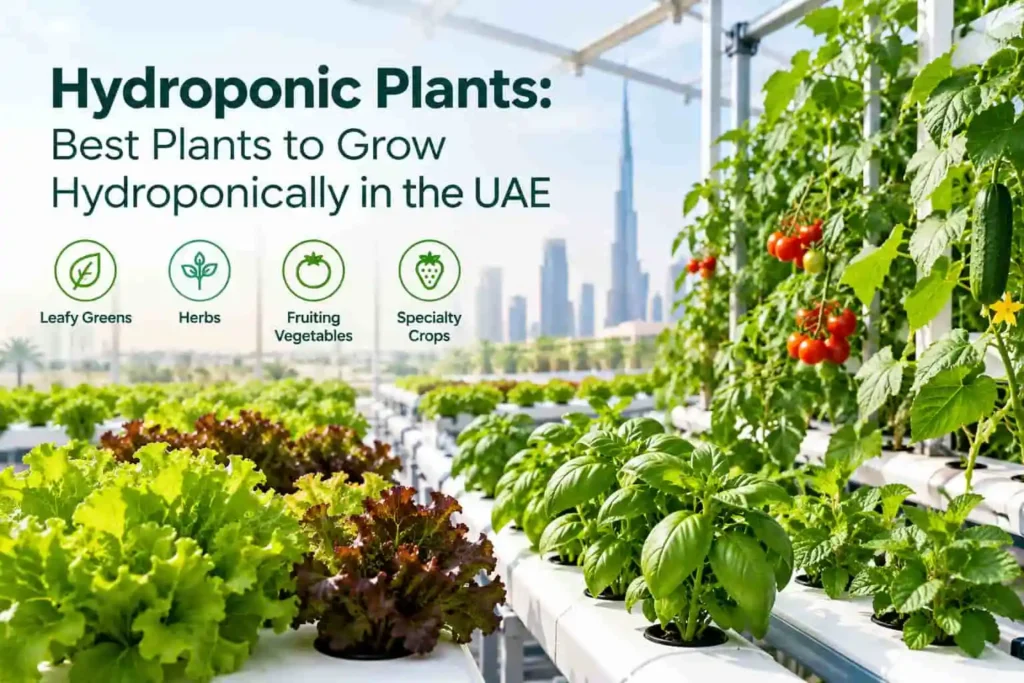
Hydroponic plants are becoming an increasingly important part of modern agriculture, particularly in regions where water availability, soil quality, land availability and climate create challenges for conventional farming.
Instead of relying on soil, hydroponic systems deliver water, oxygen and dissolved nutrients directly to the plant’s root zone. This gives growers greater control over the growing environment and makes it possible to produce vegetables, herbs and fruiting crops in greenhouses, indoor farms and other controlled environments.
For the UAE, hydroponics is particularly relevant. The country has an arid climate, limited natural water resources and challenging agricultural conditions. The UAE Ministry of Energy and Infrastructure identifies agriculture as a major water-consuming sector and has highlighted technologies such as hydroponics and vertical farming as part of efforts to improve water and crop productivity.
But not every plant is equally suitable for hydroponic cultivation.
The best hydroponic plants are those whose root, nutrient, temperature, light and space requirements can be matched effectively to the chosen system.
This guide explains which plants grow well hydroponically, which systems suit different crops, how to select plants for UAE conditions, and what growers should consider before starting a hydroponic farm.
What Are Hydroponic Plants?
Hydroponic plants are plants grown without conventional agricultural soil, with their roots receiving water and essential mineral nutrients through a controlled growing system.
Some systems grow plants directly in a nutrient solution, while others use an inert or relatively low-nutrient growing medium such as coco coir, perlite or expanded clay.
According to Oklahoma State University Extension, hydroponics involves growing plants in a liquid nutrient solution either with or without artificial growing media. Common media include expanded clay, coir and perlite.
The absence of soil does not mean plants receive fewer nutrients.
Instead, growers control the root-zone environment by managing factors such as:
- Water availability
- Nutrient concentration
- pH
- Electrical conductivity (EC)
- Dissolved oxygen
- Temperature
- Light
- Humidity
- Root-zone aeration
This level of control is one of the main reasons hydroponics can be useful for protected and controlled-environment agriculture.
How Do Hydroponic Plants Grow Without Soil?
In conventional farming, soil performs several functions. It physically supports the plant, stores water and nutrients, and provides an environment where roots can access oxygen.
Hydroponic systems separate these functions.
The plant may be supported by a growing medium or a net pot while its roots receive a carefully managed nutrient solution.
A simplified hydroponic growing cycle looks like this:
Water → Nutrients → Root Zone → Plant → Growth → Harvest
The grower controls the conditions around the roots rather than depending on the natural properties of field soil.
This makes hydroponics particularly useful where suitable agricultural soil is limited.
What Plants Can Be Grown Hydroponically?
A surprisingly large number of plants can be grown hydroponically.
However, commercial hydroponic production generally focuses on crops that provide a practical combination of:
- Market demand
- Short or manageable production cycles
- Suitable plant size
- Compatible root systems
- Reasonable environmental requirements
- Suitable hydroponic system compatibility
- Consistent harvest quality
Common hydroponic crops include:
| Plant/Crop | Common Hydroponic Systems | General Suitability |
|---|---|---|
| Lettuce | NFT, DWC, raft | Excellent |
| Basil | NFT, DWC, media systems | Excellent |
| Mint | DWC, NFT, media systems | Excellent |
| Coriander/Cilantro | NFT, DWC, media systems | Good |
| Spinach | NFT, DWC | Good |
| Kale | NFT, DWC, media systems | Good |
| Arugula | NFT, DWC | Good |
| Tomatoes | Dutch Bucket, drip systems | Excellent with support |
| Cucumbers | Dutch Bucket, drip systems | Excellent with support |
| Peppers | Dutch Bucket, drip systems | Good |
| Strawberries | NFT, towers, substrate systems | Good with climate control |
| Microgreens | Trays, vertical systems | Excellent |
| Herbs | NFT, DWC, media systems | Excellent |
The USDA National Agricultural Library also identifies hydroponics as a production method used for ornamental crops, herbs and vegetables including cucumbers, lettuce, peppers and tomatoes.
1. Lettuce
Lettuce is one of the most practical crops for hydroponic production.
Its relatively compact size, short production cycle and compatibility with systems such as Nutrient Film Technique (NFT) and Deep Water Culture (DWC) make it particularly suitable for controlled environments.
Lettuce can also be planted at relatively high densities compared with large fruiting crops.
Why lettuce works well hydroponically
- Compact growth habit
- Fast production compared with many fruiting crops
- Suitable for NFT and DWC
- Relatively straightforward nutrient management
- Suitable for vertical farming
- Consistent demand from food-service and retail markets
Lettuce is also one of the crops for which Oklahoma State University provides specific hydroponic EC and pH guidance.
For UAE growers, temperature management becomes particularly important because leafy greens generally perform better under moderate temperatures than during extreme summer heat.
2. Basil
Basil is another highly suitable hydroponic herb.
It can be grown in systems including NFT, DWC and various media-based setups.
Basil has several characteristics that make it attractive to hydroponic growers:
- Compact structure
- Repeated harvesting
- Strong culinary demand
- Good compatibility with controlled environments
- Suitable for small and commercial systems
Basil also has a relatively specific nutrient environment. Oklahoma State University’s hydroponic nutrient guide lists a typical EC range of approximately 1.0–1.6 mS/cm and a pH range of approximately 5.5–6.0, although actual targets should be adjusted according to cultivar, growth stage, water quality and the nutrient program being used.
3. Mint
Mint is particularly interesting for hydroponic production because it can be harvested repeatedly.
Rather than treating every crop as a one-time harvest, growers can establish plants and harvest portions of the foliage while allowing the plant to continue producing new growth.
Mint can be grown using several hydroponic approaches, provided that the system supplies adequate water, nutrients, oxygen and support.
For commercial production, the important question is not simply whether mint can grow hydroponically.
It is whether the grower can maintain:
- Consistent quality
- Clean production
- Appropriate temperature
- Reliable nutrient management
- Consistent harvest schedules
- A market for the harvested herb
4. Coriander and Cilantro
Coriander, commonly called cilantro when the leaves are harvested, can also be grown hydroponically.
It is particularly suitable for systems designed for leafy herbs.
The main challenge is environmental control.
Like many cool-season leafy crops, coriander can become difficult to manage when temperatures rise substantially. Therefore, UAE growers need to consider seasonal production and climate control rather than assuming that every crop can be grown outdoors throughout the year.
For commercial operations, succession planting can also help maintain a continuous harvest.
Instead of planting the entire production area at once, growers can establish smaller batches at regular intervals.
5. Spinach
Spinach can be grown in hydroponic systems such as NFT and DWC.
It is a leafy crop, so it does not require the same structural support as large fruiting plants such as tomatoes or cucumbers.
The crop is generally more suited to controlled environments where temperature and nutrient conditions can be managed consistently.
Spinach also has different nutrient requirements from crops such as tomatoes.
Oklahoma State University lists spinach at approximately 1.8–2.3 mS/cm EC and pH 6.0–7.0 as general hydroponic reference values.
These values should be treated as crop-management references rather than universal settings.
6. Kale
Kale is another leafy vegetable that can be incorporated into hydroponic production.
Depending on the cultivar and production objective, growers can harvest young leaves or allow plants to develop larger foliage.
Kale can work in:
- NFT systems
- DWC systems
- Media-based systems
- Vertical growing systems
Its relatively robust structure can also make it useful for growers who want to diversify a leafy-green production system beyond lettuce.
7. Arugula
Arugula is another compact leafy crop that fits naturally into hydroponic production.
Its small plant size makes it compatible with systems designed for leafy greens and herbs.
Commercial growers should evaluate:
- Cultivar selection
- Plant density
- Temperature
- Harvest stage
- Nutrient management
- Market demand
As with other leafy greens, the economics depend on the market rather than simply the biological ability of the plant to grow.
8. Tomatoes
Tomatoes are among the best-known fruiting crops grown hydroponically.
Unlike lettuce and many herbs, tomatoes develop substantial stems, foliage and fruit loads. Consequently, they require a hydroponic system that provides adequate root support and a structure for training the plant.
Common commercial approaches include:
- Dutch Bucket systems
- Drip irrigation systems
- Substrate-based systems
Tomatoes also require careful management of nutrition, irrigation, light, temperature and plant support.
Oklahoma State University lists tomatoes among the major vegetables successfully produced through hydroponics.
For UAE production, climate control becomes especially important because high temperatures can interfere with flowering, fruit development and overall plant performance.
9. Cucumbers
Cucumbers are vigorous plants and can perform well in hydroponic systems when adequate support and irrigation are provided.
They are particularly suited to systems where individual plants can receive controlled irrigation and where vines can be trained vertically.
Dutch Bucket and drip-based systems are commonly considered for larger fruiting crops.
Because cucumbers develop substantial foliage, growers need to plan the system around:
- Vertical support
- Plant spacing
- Irrigation frequency
- Root-zone oxygen
- Temperature
- Humidity
- Disease management
Hydroponics can provide excellent control, but it does not remove the need for good crop management.
10. Peppers and Chillies
Peppers and chillies are also suitable for hydroponic production.
They are generally better suited to larger systems than compact leafy-green installations because mature plants require more space and support.
Oklahoma State University’s hydroponic crop reference includes peppers and provides crop-specific EC and pH ranges, illustrating why nutrient management needs to be adjusted according to the crop rather than using a single nutrient setting for every plant.
For UAE growers, varieties should be selected according to:
- Temperature tolerance
- Plant size
- Market requirements
- Production cycle
- Fruit characteristics
- Available climate-control infrastructure
11. Strawberries
Strawberries can be produced hydroponically, particularly in controlled environments.
They are different from leafy greens because fruit production introduces additional considerations such as:
- Flowering
- Pollination
- Fruit development
- Temperature
- Light
- Plant support
- Disease prevention
NFT channels, vertical towers and substrate-based systems can all be used depending on the production design.
In the UAE, climate control is especially important because strawberry production requires environmental conditions that may be difficult to maintain during extreme outdoor temperatures.
12. Microgreens
Microgreens are another crop category that works extremely well in controlled growing environments.
They require relatively little space and can be produced in trays or vertically stacked production areas.
Common microgreens include:
- Radish
- Pea shoots
- Sunflower
- Broccoli
- Mustard
- Kale
- Amaranth
Microgreens are often better considered a controlled-environment crop category rather than a traditional hydroponic crop because different production methods can be used.
The key commercial consideration is the relationship between production cost, harvest time, shelf life and market demand.
Hydroponic Plants by Growing System
Choosing the plant and choosing the hydroponic system are closely connected.
A system designed for lettuce is not necessarily the right system for a mature tomato plant.
NFT — Nutrient Film Technique
NFT continuously or intermittently moves a shallow film of nutrient solution through growing channels.
It is particularly suitable for:
- Lettuce
- Basil
- Coriander
- Arugula
- Spinach
- Other leafy greens
NFT is especially attractive where efficient use of space and water are important.
DWC — Deep Water Culture
In DWC, plant roots are suspended in nutrient-rich water while oxygen is supplied to the root zone.
It can be suitable for:
- Lettuce
- Herbs
- Leafy greens
Because the root system is directly associated with the nutrient reservoir, oxygenation and water management are critical.
Dutch Bucket Systems
Dutch Bucket systems are better suited to larger fruiting plants.
Common crops include:
- Tomatoes
- Cucumbers
- Peppers
- Eggplants
Individual plants can be supported in separate containers filled with growing media while nutrient solution is delivered through irrigation lines.
Drip Hydroponic Systems
Drip systems deliver nutrient solution directly to individual plants.
They are particularly useful for larger plants where individual root-zone management is advantageous.
Typical crops include:
- Tomatoes
- Cucumbers
- Peppers
- Strawberries
- Eggplants
The right choice ultimately depends on crop type, scale, climate, available infrastructure and production objectives.
Which Hydroponic Plants Are Best for the UAE?
There is no single “best” hydroponic plant for every UAE farm.
Crop selection should be based on the interaction between climate, crop requirements, production system and market demand.
The UAE’s agricultural environment makes this particularly important.
The UAE Government states that hydroponics has been prioritised as a technology that can use nutrient-rich water with little or no soil, and its agriculture information portal notes potential water savings of up to 70% associated with hydroponic technology.
The country’s Ministry of Energy and Infrastructure also identifies agriculture as a major water-consuming sector and has highlighted hydroponic and vertical farming technologies under programmes focused on improving water and crop productivity.
For UAE production, growers should therefore consider crops in categories.
Leafy greens
Examples:
- Lettuce
- Spinach
- Kale
- Arugula
These are often well suited to NFT, DWC and vertical systems.
Culinary herbs
Examples:
- Basil
- Mint
- Coriander
- Parsley
These can be suitable for compact hydroponic systems and controlled environments.
Fruiting vegetables
Examples:
- Tomatoes
- Cucumbers
- Peppers
- Chillies
- Eggplants
These require more space, structural support and crop management.
Specialty crops
Examples:
- Strawberries
- Microgreens
- Premium herbs
These may offer opportunities where the production environment and target market justify the additional management requirements.
Why Climate Control Matters for Hydroponic Plants in the UAE?
Hydroponics does not eliminate the UAE’s climate.
It simply gives growers more tools to manage the environment around the plant.
The UAE is an arid country with limited natural water resources, and the government has identified water security as a national priority.
That means commercial hydroponic production needs to consider more than irrigation efficiency.
A serious growing operation may need to manage:
- Air temperature
- Root-zone temperature
- Relative humidity
- Ventilation
- Solar radiation
- Shading
- Cooling
- Irrigation
- Nutrient concentration
- pH
- EC
- Pest pressure
This is where hydroponics and greenhouse technology increasingly overlap.
A properly designed controlled environment can allow growers to create conditions suitable for crops that would otherwise struggle during the hottest periods.
Hydroponic Nutrient Management
One of the biggest misconceptions about hydroponic plants is that water alone is enough.
It is not.
Plants still require essential mineral nutrients, including:
Macronutrients
- Nitrogen
- Phosphorus
- Potassium
- Calcium
- Magnesium
- Sulfur
Micronutrients
- Iron
- Manganese
- Zinc
- Copper
- Boron
- Molybdenum
- Chlorine
The exact concentration depends on the crop and growth stage.
Two important measurements are pH and electrical conductivity (EC).
pH affects nutrient availability, while EC provides an indication of the concentration of dissolved salts in the nutrient solution.
Oklahoma State University notes that, unlike soil, soilless systems do not have the same natural buffering capacity, making artificial management of pH and EC particularly important.
For this reason, growers should avoid using a single nutrient recipe for every hydroponic plant.
Common Problems When Growing Hydroponic Plants
Hydroponics can be highly controlled, but it is not maintenance-free.
Some common problems include:
Root Rot
Poor oxygenation, excessive moisture and pathogen pressure can damage roots.
A healthy hydroponic system needs an appropriately oxygenated root environment.
Nutrient Imbalance
Incorrect nutrient concentrations can result in:
- Yellowing leaves
- Poor growth
- Leaf-edge damage
- Weak stems
- Poor fruit development
Incorrect pH
A nutrient solution can contain adequate minerals but still produce deficiencies if the pH is outside the appropriate range for the crop.
Algae Growth
Light reaching nutrient solution can encourage algae growth.
Reducing unnecessary light exposure to reservoirs and channels can help manage the problem.
High Temperatures
This is especially relevant to UAE growers.
Heat can influence:
- Root health
- Nutrient uptake
- Transpiration
- Flowering
- Pollination
- Fruit quality
- Dissolved oxygen
That is why system design should account for the local climate from the beginning.
Hydroponic Plants vs Soil-Grown Plants
Hydroponics and soil farming are not simply two versions of the same production method.
They involve different management approaches.
| Factor | Hydroponic Production | Soil Production |
|---|---|---|
| Growing medium | Water/nutrient solution or inert media | Soil |
| Nutrient control | Highly controllable | Influenced by soil properties |
| Root environment | Can be precisely managed | Depends on soil structure |
| Land requirement | Can be highly space-efficient | Usually requires field area |
| Water management | Recirculation possible | Depends on irrigation method and soil |
| Climate control | Often combined with protected cultivation | Usually more exposed outdoors |
| Technical requirement | Higher | Varies |
| Monitoring | Frequent | Depends on production system |
| Crop choice | Broad but system-dependent | Broad |
The important point is that hydroponics is not automatically superior for every crop or every farm.
Its value comes from where controlled root-zone management, efficient use of space and protected production provide practical advantages.
How to Choose the Right Hydroponic Plants for a Commercial Farm?
If you are planning a commercial hydroponic project, do not begin by asking:
“What is the most profitable hydroponic plant?”
Begin with a more useful set of questions:
1. Who will buy the crop?
Potential markets include:
- Supermarkets
- Restaurants
- Hotels
- Food distributors
- Catering businesses
- Direct consumers
2. What does the market actually demand?
A crop that grows quickly is not necessarily commercially attractive if there is insufficient demand.
3. What climate can you maintain?
Consider the temperature and humidity requirements of the crop and the cost of maintaining them.
4. Which hydroponic system fits the crop?
Match the root architecture, plant size and irrigation requirements to the system.
5. What is the production cycle?
Short-cycle leafy greens and long-cycle fruiting crops have very different labour, infrastructure and cash-flow requirements.
6. How much space does each plant need?
Plant density directly affects how efficiently the growing area can be used.
7. What level of technical management is available?
Commercial hydroponics requires monitoring and operational discipline.
Hydroponic Plants and Vertical Farming
Hydroponics and vertical farming are often discussed together, but they are not the same thing.
Hydroponics describes how plants receive water and nutrients.
Vertical farming describes how growing space is arranged.
A vertical farm can use hydroponics, aeroponics or other growing methods.
Hydroponic systems can therefore be incorporated into vertical farming to increase production density where the crop is suitable.
Leafy greens and herbs are particularly compatible with this approach because they are compact and can be grown in multiple stacked levels.
For larger crops such as tomatoes and cucumbers, the vertical concept usually involves training plants upward rather than stacking multiple crop layers.
Hydroponic Plants and Controlled Environment Agriculture
Hydroponics is one component of Controlled Environment Agriculture (CEA).
CEA combines technologies and management practices to create controlled growing conditions.
Depending on the project, this can include:
- Greenhouses
- Hydroponic systems
- Automated irrigation
- Climate control
- Sensors
- Environmental monitoring
- Lighting
- Nutrient management
- Crop monitoring
- Automation
This integrated approach is particularly relevant in climates where outdoor conditions can restrict crop production.
For UAE agriculture, controlled-environment systems can help growers manage the environmental variables that are difficult to control outdoors.
Frequently Asked Questions About Hydroponic Plants
What are the easiest plants to grow hydroponically?
Leafy greens and herbs such as lettuce, basil, mint, coriander and arugula are generally among the more practical crops for beginners because of their relatively compact growth and compatibility with simple hydroponic systems.
Can any plant be grown hydroponically?
No. Many plant species can be adapted to hydroponic production, but practical suitability varies. Large plants, trees and crops with extensive root or structural requirements may require specialised systems and may not be economically sensible for hydroponics.
What is the best hydroponic plant for beginners?
Lettuce and herbs are useful starting points because they can be grown in systems such as NFT and DWC and generally require less structural support than fruiting crops.
Can hydroponic plants grow in the UAE?
Yes. Hydroponic production is already recognised as an agricultural technology in the UAE, and the UAE Government identifies hydroponics as a method that can use nutrient-rich water with little or no soil.
However, crop selection and environmental control are critical because UAE temperatures can create challenging growing conditions.
Do hydroponic plants need sunlight?
Plants require light for photosynthesis, but the source can be natural sunlight, supplemental lighting or artificial grow lighting depending on the growing environment and crop.
Do hydroponic plants need soil?
No. Hydroponic systems are designed to grow plants without conventional soil. Some systems use inert media to support the plant and root structure.
What nutrients do hydroponic plants need?
Hydroponic plants require the same essential mineral nutrients needed for plant growth in other production systems. The difference is that the grower supplies and manages those nutrients through the nutrient solution.
What is pH in hydroponics?
pH indicates how acidic or alkaline the nutrient solution is. Maintaining an appropriate pH is important because nutrient availability is affected by pH.
What is EC in hydroponics?
Electrical conductivity, or EC, is commonly used as an indicator of dissolved nutrient/salt concentration in hydroponic solutions. The appropriate range varies between crops and growth stages.
Are hydroponic plants suitable for commercial farming?
Yes, hydroponics can be used commercially for crops including lettuce, herbs, tomatoes, cucumbers and peppers. However, commercial success depends on system design, crop selection, environmental control, operating costs, labour, market demand and production consistency.
Final Thoughts: Choosing Hydroponic Plants the Right Way
The most important lesson in hydroponic farming is that crop selection should come before system selection—and system selection should come before installation.
Lettuce, basil, mint, coriander, spinach and other leafy crops can be well suited to compact hydroponic systems. Tomatoes, cucumbers and peppers can also perform well but require more space, support and environmental management.
For UAE growers, the decision becomes even more important because the local climate and water environment place additional demands on agricultural production.
The UAE Government has identified hydroponics as one of the technologies that can contribute to more efficient agricultural production, while national programmes are also focused on improving water and crop productivity.
The strongest hydroponic operation is therefore not necessarily the one growing the largest number of crops.
It is the one where crop, system, climate, nutrients, automation and market demand are designed to work together.
For commercial projects, a properly engineered hydroponic system can become part of a broader controlled-environment agriculture strategy—combining efficient irrigation, environmental monitoring, automation and crop management into a single production system.

