
Quick Answer
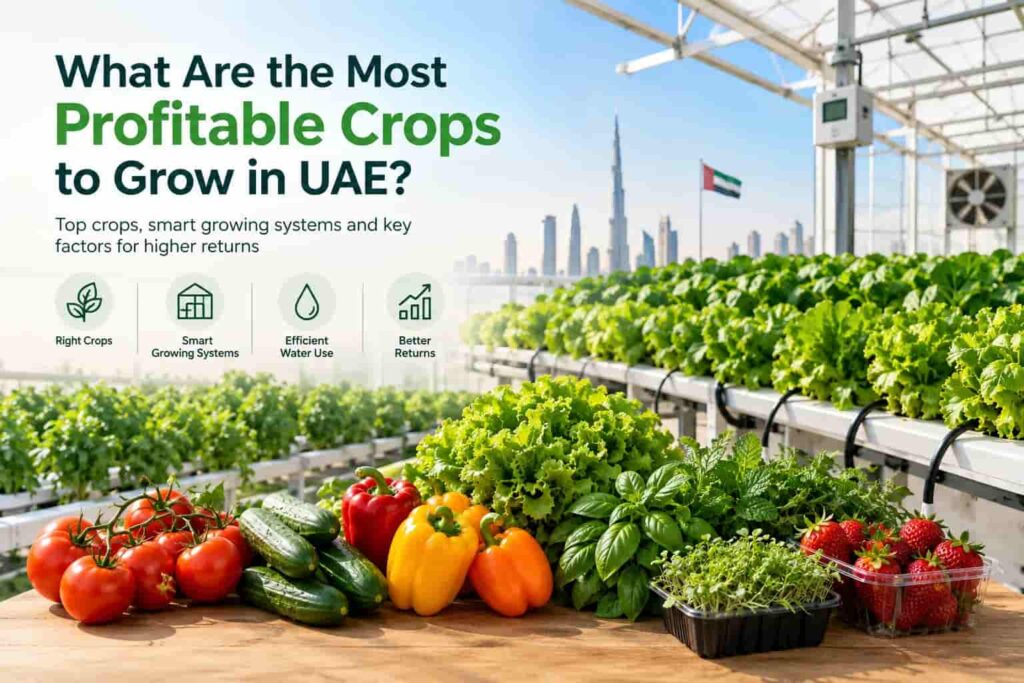
“Some of the most commercially promising crops to grow in the UAE include tomatoes, cucumbers, peppers, leafy greens, herbs and strawberries, particularly when grown using greenhouses, hydroponics or other controlled-environment systems. The UAE’s climate, limited water resources and soil conditions make crop selection and production technology important factors in farm profitability. Tomatoes, cucumbers and other greenhouse vegetables are already supported by UAE agricultural initiatives and research into water-efficient production systems.”
The UAE has some of the most challenging agricultural conditions in the world. High temperatures, limited freshwater resources, low rainfall, sandy soils, and extreme summer conditions make traditional farming difficult in many parts of the country.
At the same time, the UAE has a growing demand for locally produced fresh vegetables, herbs, fruits, and specialty crops. This has created significant opportunities for farmers and agribusinesses using greenhouses, hydroponics, vertical farming, controlled environment agriculture, and agricultural automation.
But what are the most profitable crops to grow in the UAE?
There is no single crop that guarantees the highest profit for every farm. Profitability depends on several factors, including crop yield, selling price, production cycle, water consumption, labour requirements, energy costs, farm size, growing technology, climate control, and access to reliable markets.
For commercial growers, the better question is not simply “Which crop sells for the highest price?” but:
Which crop can generate the best return from my available land, water, technology, labour, capital, and target market?
This guide explores some of the most commercially attractive crops for UAE agriculture and explains how growers can evaluate crop profitability before investing in a farming system.
What Makes a Crop Profitable in the UAE?
A profitable crop needs more than a high selling price.
For UAE farms, profitability is usually influenced by a combination of the following factors.
1. Selling Price
Crops with strong market demand and higher selling prices can generate better revenue per growing area.
However, a high selling price does not automatically mean high profitability. If the crop also requires expensive climate control, specialized labor, long production cycles, or significant energy consumption, the final margin may be lower than expected.
2. Yield per Square Meter
For greenhouse, hydroponic, and vertical farms, production per square meter is extremely important.
A crop that produces consistent yields from a relatively small growing area can be attractive for farms where land is expensive or limited.
3. Crop Cycle
Short-cycle crops can be harvested multiple times throughout the year.
For example, leafy greens and some herbs can have relatively short production cycles compared with crops that require several months before producing commercial quantities.
A shorter cycle can potentially allow a farm to generate revenue more frequently.
4. Water Requirements
Water efficiency is particularly important in the UAE.
Crops that can be efficiently produced through hydroponics, drip irrigation, fertigation, or other controlled systems may provide better resource efficiency than traditional open-field production.
5. Climate Requirements
The UAE’s extreme summer temperatures can significantly affect crop production.
Some crops require extensive cooling, shading, ventilation, humidity management, or other environmental controls.
The cost of maintaining suitable growing conditions must therefore be included in the crop profitability calculation.
6. Labour Requirements
Labour can represent a significant operating expense.
Crops that require frequent pruning, pollination, harvesting, grading, or other manual activities may require more workers than highly automated crops.
7. Energy Consumption
Energy is particularly important for indoor farms and climate-controlled greenhouses.
Cooling systems, ventilation, lighting, pumps, fertigation equipment, sensors, and automation systems can all contribute to operating costs.
8. Market Demand
Before selecting a crop, farmers should identify who will buy it.
Potential customers may include:
- Supermarkets
- Restaurants
- Hotels
- Food distributors
- Catering companies
- Wholesale markets
- Food processors
- Direct consumers
- Specialty food businesses
A crop should ideally have a clear route to market before commercial production begins.
9. Shelf Life
Perishable crops can create additional challenges.
Leafy greens, herbs, berries, and microgreens may have relatively short shelf lives, making harvesting, packaging, cold storage, transportation, and distribution particularly important.
10. Production Consistency
Commercial buyers generally need consistent quality and supply.
A crop that performs well only during certain periods of the year may require additional investment in environmental control to maintain year-round production.
Most Profitable Crops to Grow in UAE
Several crops have strong potential for commercial production in the UAE, particularly when grown using protected agriculture and controlled growing systems.1. Tomatoes
Tomatoes are among the most important vegetable crops for commercial protected agriculture.
They can be produced in greenhouses using soil-based systems, hydroponics, substrate systems, and other controlled growing methods.
Why tomatoes can be profitable
- Strong consumer demand
- Multiple varieties and market segments
- Suitable for greenhouse production
- Potential for extended production cycles
- Suitable for hydroponic and fertigation systems
- Opportunities for premium varieties
Specialty tomatoes such as cherry tomatoes, cocktail tomatoes, and other premium varieties may provide additional opportunities when supported by the right market.
However, commercial tomato production requires careful management of temperature, humidity, irrigation, nutrients, pests, pollination, and plant health.
For large-scale greenhouse operations, tomatoes can be particularly attractive when production systems are designed around consistent quality and efficient resource management.
2. Cucumbers
Cucumbers are another crop with strong potential for greenhouse and protected cultivation in the UAE.
They grow relatively quickly and can produce multiple harvests during a production cycle.
Advantages of growing cucumbers commercially
- Strong market demand
- Relatively fast production
- Suitable for greenhouse cultivation
- Suitable for hydroponic systems
- High production potential per growing area
- Compatible with vertical training systems
Cucumber profitability depends heavily on temperature management, irrigation, humidity control, plant density, disease prevention, and harvesting practices.
In hot climates, maintaining an appropriate greenhouse environment becomes particularly important.
3. Bell Peppers
Bell peppers can be a valuable commercial crop for controlled-environment agriculture.
Different colours and varieties can target different market segments, including premium retail and food-service markets.
Why bell peppers can be attractive
- Strong demand
- Premium varieties available
- Suitable for protected cultivation
- Can be produced using hydroponic systems
- Potential for consistent quality
- Suitable for controlled environments
However, peppers generally require careful environmental management.
Temperature, humidity, nutrition, irrigation, pollination, and crop duration can all influence production costs and final returns.
4. Lettuce and Leafy Greens
Leafy greens are particularly interesting for hydroponic and vertical farming operations.
Common examples include:
- Lettuce
- Romaine lettuce
- Butterhead lettuce
- Iceberg varieties
- Arugula
- Kale
- Spinach
- Asian greens
- Mixed salad greens
Why leafy greens are attractive?
Many leafy greens have relatively short growing cycles, which can allow commercial farms to produce multiple crop cycles throughout the year.
They also work well with:
- NFT hydroponics
- Deep water culture
- Vertical farming
- Indoor farming
- Controlled environment agriculture
- Greenhouse production
The main challenge is market positioning.
A commercial grower needs to understand the required volume, packaging, freshness expectations, selling price, and distribution requirements before investing heavily in production capacity.
5. Fresh Herbs
Fresh herbs can provide attractive opportunities for UAE growers, particularly when production is connected to restaurants, hotels, supermarkets, catering companies, and other food-service businesses.
Popular crops include:
- Basil
- Mint
- Coriander
- Parsley
- Rosemary
- Thyme
- Oregano
- Chives
Hydroponic production can be particularly suitable for herbs because growers can control water and nutrient delivery while producing consistent crops in protected environments.
Why herbs can be commercially attractive?
- High demand from food-service businesses
- Multiple varieties
- Suitable for hydroponic production
- Frequent harvesting opportunities
- Potential premium for fresh, locally produced products
- Relatively small growing area requirements for some crops
For herbs, freshness and delivery speed can be just as important as production volume.
6. Strawberries
Strawberries are a premium crop that can be produced under controlled environmental conditions.
The UAE’s climate makes open-field strawberry production challenging, particularly during hot periods. Greenhouses and other controlled systems can provide a more suitable environment.
Potential advantages
- Premium retail market
- Strong demand for fresh berries
- Suitable for protected cultivation
- Can be grown using soilless systems
- Potential for high value per growing area
However, strawberries can require significant environmental management.
Temperature, humidity, irrigation, nutrition, pollination, disease prevention, harvesting, and post-harvest handling all need careful attention.
Therefore, strawberry production should be evaluated based on the entire production and marketing system rather than simply the selling price.
7. Microgreens
Microgreens represent a different type of agricultural opportunity.
They are generally produced indoors or in highly controlled environments and can be harvested relatively quickly.
Popular microgreens include:
- Radish
- Pea shoots
- Sunflower
- Broccoli
- Mustard
- Basil
- Amaranth
- Coriander
Why microgreens can be attractive?
- Short production cycles
- Small space requirements
- Premium positioning
- Suitable for indoor farming
- Can be produced close to customers
- Potential demand from restaurants and premium food businesses
The main challenge is market size.
A farm should establish reliable buyers before scaling production because microgreens are highly perishable and their customer base can be more specialised than mainstream vegetables.
8. Specialty and Premium Crops
The UAE market can also support specialised crops aimed at premium consumers and commercial buyers.
Examples may include:
- Specialty tomatoes
- Premium lettuce
- Exotic herbs
- Edible flowers
- Premium berries
- Specialty salad greens
- Selected Asian vegetables
- High-value culinary herbs
These crops can potentially achieve higher selling prices, but their markets may be smaller.
The key is to match production with actual customer demand.
Producing an expensive crop without a reliable market can create more risk than producing a conventional crop with predictable demand.
Profitable Crops for Different Farming Systems
The most suitable crop can change depending on the production technology being used.
| Crop | Commercial Potential | Suitable Systems | Key Considerations |
|---|---|---|---|
| Tomatoes | High | Greenhouse, hydroponics | Climate control and crop management |
| Cucumbers | High | Greenhouse, hydroponics | Temperature and water management |
| Bell Peppers | High | Greenhouse, hydroponics | Long crop cycle and environmental control |
| Lettuce | High | Hydroponics, vertical farming, greenhouse | Market demand and crop turnover |
| Basil | High potential | Hydroponics, greenhouse | Freshness and market access |
| Mint | High potential | Hydroponics, greenhouse | Harvest frequency and demand |
| Coriander | High potential | Hydroponics, greenhouse | Temperature sensitivity |
| Strawberries | Premium potential | Greenhouse, soilless systems | Climate control and labour |
| Microgreens | Niche/high-value | Indoor, vertical farming | Sales channels and shelf life |
| Specialty crops | Variable | Greenhouse, CEA | Premium market size |
Is Greenhouse Farming More Profitable Than Open-Field Farming in the UAE?
Greenhouse farming can provide important advantages in the UAE because it gives growers greater control over the growing environment.
A greenhouse can help manage factors such as:
- Temperature
- Humidity
- Light
- Irrigation
- Nutrient delivery
- Ventilation
- Pest exposure
- Crop protection
This can make it possible to produce crops during periods when outdoor conditions are less suitable.
However, greenhouse farming also requires capital investment.
Costs may include:
- Greenhouse structures
- Cooling systems
- Ventilation
- Shade systems
- Irrigation
- Fertigation
- Sensors
- Automation
- Climate-control systems
- Labour
- Energy
- Maintenance
Therefore, the correct question is not whether greenhouses are automatically more profitable.
The question is whether the additional production, quality, crop availability, and resource efficiency generated by the greenhouse justify the investment and operating costs.
How Hydroponics Can Change Crop Economics?
Hydroponic farming allows plants to grow without traditional agricultural soil.
Instead, plants receive water and nutrients through a controlled growing system.
Depending on the design, hydroponic farms can provide advantages such as:
- Efficient water management
- Precise nutrient delivery
- High production density
- Reduced dependence on soil quality
- Greater control over the root environment
- Compatibility with vertical farming
- Potential for year-round production
Hydroponics can be particularly useful in regions where water and suitable agricultural land are limited.
However, hydroponics is not automatically profitable.
The economics depend on crop selection, electricity costs, system design, labour, nutrient management, maintenance, yield, selling price, and market access.
Why Water Quality Matters When Selecting Crops?
Water is one of the most important considerations for UAE agriculture.
For hydroponic farms, water quality becomes even more important because the same water and nutrient system directly affects the crop’s root environment.
Factors such as:
- Salinity
- Electrical conductivity
- pH
- Mineral composition
- Alkalinity
- Water temperature
can influence crop performance and nutrient availability.
Before selecting a crop or hydroponic system, commercial growers should understand the quality of their available water.
Water treatment may also be required depending on the source and intended production system.
How to Choose the Most Profitable Crop for Your UAE Farm?
Instead of choosing a crop simply because it appears profitable, use a structured process.
Step 1: Identify Your Target Market
Determine who you plan to sell to.
For example:
- Supermarkets
- Restaurants
- Hotels
- Wholesale distributors
- Food-service companies
- Direct consumers
Understanding the buyer helps determine the appropriate crop, variety, packaging, quality, and production volume.
Step 2: Calculate Revenue per Square Metre
For controlled agriculture, revenue per square metre can be more useful than simply looking at the price per kilogram.
Consider:
Expected yield × selling price = potential gross revenue
Then compare this against production costs.
Step 3: Calculate the Full Production Cost
Include all relevant expenses:
- Seeds
- Growing media
- Nutrients
- Water
- Electricity
- Labour
- Packaging
- Transportation
- Maintenance
- Pest management
- Climate control
- Equipment depreciation
- Land or facility costs
Ignoring these expenses can create an unrealistic picture of profitability.
Step 4: Consider the Crop Cycle
A crop producing a moderate margin several times per year may have a different economic profile from a crop producing a higher margin once over a longer period.
Crop turnover should therefore be included in the financial model.
Step 5: Consider UAE Summer Conditions
Summer production deserves particular attention.
A crop that performs well during the cooler months may require substantial cooling during the hottest periods.
The additional energy cost can significantly influence profitability.
Step 6: Evaluate Water Quality
Test the available water before finalising the production system.
This is particularly important for hydroponic farms.
Step 7: Avoid Depending on a Single Crop
Commercial farms can consider diversification where appropriate.
For example, a farm may combine:
- Leafy greens
- Herbs
- Tomatoes
- Cucumbers
- Specialty crops
The exact combination should depend on available infrastructure and market demand.
What Is the Most Profitable Crop to Grow in UAE?
There is no universal answer.
The most profitable crop for one UAE farm may not be the most profitable crop for another.
For large greenhouse operations, crops such as tomatoes, cucumbers, and bell peppers can offer strong commercial potential.
For hydroponic and vertical farming businesses, leafy greens and herbs may be attractive because of their production cycles and compatibility with controlled systems.
For premium markets, strawberries, specialty tomatoes, microgreens, edible flowers, and other niche crops may provide additional opportunities.
Ultimately, crop profitability can be viewed through this relationship:
Crop × Technology × Climate × Water × Market × Cost × Scale = Commercial Potential
The crop is only one part of the equation.
How Modern Technology Can Improve Crop Profitability?
Modern agricultural technology can help commercial growers improve production efficiency and reduce unnecessary resource use.
Important technologies include:
Automated Irrigation
Automated irrigation systems can deliver water according to crop requirements rather than relying entirely on manual watering.
Fertigation
Fertigation combines irrigation with nutrient delivery, allowing growers to manage plant nutrition more precisely.
Climate Control
Greenhouse climate-control systems can help manage temperature, humidity, ventilation, and other environmental conditions.
Sensors
Sensors can monitor variables such as:
- Temperature
- Humidity
- Soil moisture
- Electrical conductivity
- pH
- Light
- Water conditions
Agricultural Automation
Automation can reduce repetitive manual tasks and improve consistency.
Depending on the farm, automation may include:
- Irrigation control
- Fertigation
- Climate control
- Ventilation
- Shading
- Monitoring
- Data collection
- Alerts
Data-Driven Farm Management
Farm data can help growers understand production performance and identify problems earlier.
Instead of making decisions entirely based on observation, farmers can use measurable information to optimise irrigation, nutrition, climate, and crop performance.
How Skyfield Agritech Can Help With Commercial Crop Planning?
Choosing the right crop is only the first step.
A successful commercial farm also needs the right production environment, irrigation strategy, climate management, automation, and operational planning.
Skyfield Agritech works with modern agricultural systems designed for controlled and efficient crop production.
Depending on the project requirements, commercial growers may consider solutions such as:
- Turnkey greenhouse systems
- Hydroponic systems
- Vertical farming solutions
- Controlled environment agriculture
- Greenhouse automation
- Farm management solutions
- Smart irrigation
- Agricultural automation
The right combination depends on the crop, farm size, available resources, climate conditions, target market, and commercial objectives.
Frequently Asked Questions
What is the most profitable crop to grow in UAE?
There is no single crop that is universally the most profitable. Tomatoes, cucumbers, bell peppers, leafy greens, herbs, strawberries, microgreens, and specialty crops can all offer commercial opportunities depending on the production system and market.
Which vegetables are profitable to grow in UAE greenhouses?
Tomatoes, cucumbers, bell peppers, lettuce, and various leafy greens can be suitable for greenhouse production. The most appropriate crop depends on the greenhouse environment, production technology, market demand, and operating costs.
Are leafy greens profitable in UAE?
Leafy greens can be commercially attractive because many varieties have relatively short production cycles and are suitable for hydroponic, greenhouse, and vertical farming systems.
Is hydroponic farming profitable in UAE?
Hydroponic farming can be profitable when the crop, system design, operating costs, production volume, and market are properly aligned. Profitability should be calculated using the complete cost of production rather than crop selling price alone.
Which crops are suitable for hydroponic farming in UAE?
Common hydroponic crops include lettuce, basil, mint, coriander, arugula, spinach, kale, tomatoes, cucumbers, peppers, strawberries, and microgreens.
Is greenhouse farming suitable for the UAE climate?
Greenhouse farming can be highly useful in the UAE because it provides greater control over the growing environment. However, greenhouse design must account for the country’s high temperatures, solar radiation, humidity, ventilation, cooling, and water requirements.
How do I choose a crop for a commercial farm in UAE?
Start by identifying your target market, then calculate expected yield, selling price, crop cycle, water requirements, labour, energy, climate-control requirements, infrastructure costs, and other operating expenses. The best crop is the one that fits your complete commercial model.
Final Takeaway
The UAE’s agricultural sector is moving increasingly toward controlled and resource-efficient production systems.
Greenhouses, hydroponics, vertical farming, precision agriculture, smart irrigation, and automation can help growers overcome some of the limitations associated with the UAE’s climate and water resources.
However, technology alone does not determine profitability.
The most successful commercial farms start by understanding the market and then selecting the right crop, production system, infrastructure, and management strategy around that demand.
For one farm, tomatoes or cucumbers may make commercial sense. For another, leafy greens or herbs may be more appropriate. A premium producer may instead focus on strawberries, microgreens, specialty vegetables, or other high-value crops.
The goal should not simply be to grow a crop that sells for a high price.
The goal is to build a farming system where the crop, technology, resources, operating costs, production cycle, and market work together to create a sustainable commercial business.

