
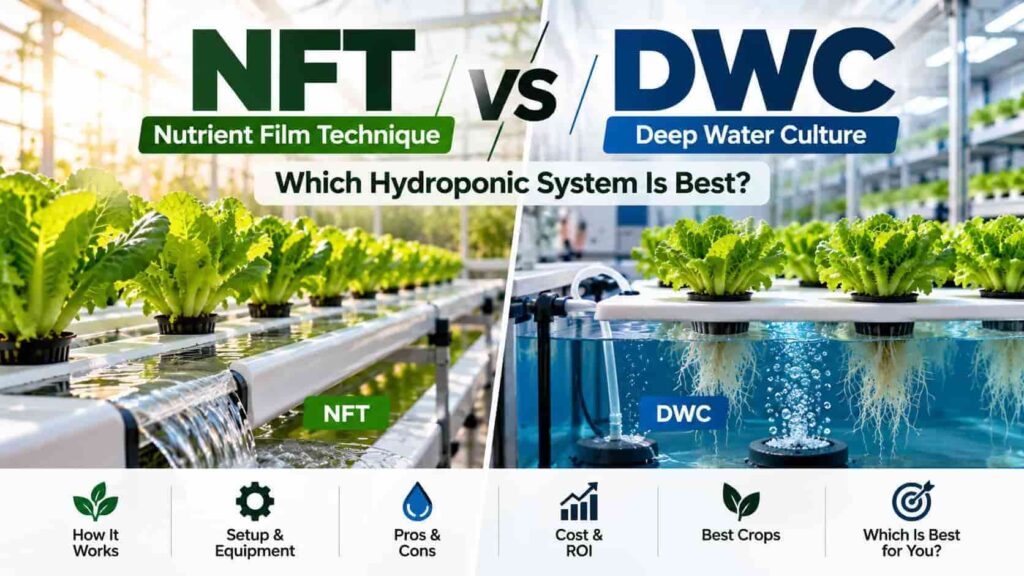
Choosing the right hydroponic system is one of the most important decisions when planning a commercial farm. Two widely used options for growing leafy greens and herbs are Nutrient Film Technique (NFT) and Deep Water Culture (DWC). Both deliver water and nutrients directly to plant roots, but they differ in system design, water management, oxygen availability, maintenance requirements and operational risks.
For growers in the UAE, the decision requires additional consideration. High ambient temperatures can affect nutrient-solution temperature, root health and crop quality. The right system must therefore be selected according to the crop, greenhouse environment, production targets, available resources and commercial objectives.
So, NFT vs DWC—which system is best?
NFT is often suitable for space-efficient, continuous-flow production, while DWC can be advantageous for crops that benefit from a larger, more stable nutrient reservoir. Neither system is universally superior. The best choice depends on the farm’s operating conditions and the crop being cultivated.
In this guide, we compare NFT and DWC hydroponic systems, including how they work, their advantages and disadvantages, installation considerations, suitable crops and their application in commercial farming in the UAE.
What Is NFT Hydroponics?
Nutrient Film Technique, commonly known as NFT, is a hydroponic growing method in which a thin, continuous stream of nutrient-rich water flows through slightly inclined channels containing plant roots.
Plants are held in openings along the channels, allowing their roots to access the circulating nutrient solution. The shallow flow leaves part of the root system exposed to air, supporting oxygen availability.
A typical NFT system includes:
- Growing channels or troughs
- A nutrient-solution reservoir
- A water circulation pump
- Nutrient dosing equipment
- Filtration and return plumbing
- pH and electrical conductivity (EC) monitoring
- A suitable support structure
The nutrient solution flows through the channels, returns to the reservoir and is recirculated.
NFT is commonly used for lettuce, basil, coriander and other leafy greens and herbs. It can be configured in horizontal channels or integrated into suitable vertical growing arrangements.
How Does an NFT System Work?
- Seedlings are raised in an appropriate growing medium.
- Young plants are transferred into the NFT channels.
- A pump circulates nutrient solution through the channels.
- Plant roots absorb water and dissolved nutrients.
- The remaining solution returns to the reservoir for reuse.
- The grower monitors pH, EC, nutrient levels, flow and water temperature.
Because the nutrient film is shallow, the system depends on reliable circulation. If a pump fails or a channel becomes blocked, roots can lose access to sufficient water quickly.
What Is DWC Hydroponics?
Deep Water Culture, or DWC, is a hydroponic method in which plant roots remain suspended in an aerated nutrient solution.
Plants are usually supported by net pots or openings in floating rafts placed above a reservoir or growing tank. The roots extend into the water, where they absorb dissolved nutrients and oxygen.
A typical DWC system includes:
- A tank or growing reservoir
- Floating rafts or plant-support panels
- Net pots or suitable plant supports
- An air pump
- Air stones or diffusers
- Nutrient-solution circulation, where required
- pH and EC monitoring equipment
- Temperature and dissolved-oxygen monitoring
Unlike NFT, DWC maintains a larger volume of nutrient solution around the roots. This can provide greater buffering against short-term changes in water level and nutrient concentration.
However, the water must remain adequately oxygenated. Insufficient dissolved oxygen, excessive solution temperature or poor sanitation can damage roots and encourage disease.
How Does a DWC System Work?
- Seedlings are established in suitable plugs or growing media.
- Plants are positioned in rafts or supports above the nutrient reservoir.
- Roots extend into the nutrient solution.
- Air pumps and diffusers supply oxygen to the water.
- Nutrients and water are replenished as plants grow.
- The grower monitors solution chemistry, temperature, oxygen and crop health.
DWC is commonly used for lettuce, leafy greens and certain herbs, particularly in floating-raft production systems.
NFT vs DWC: Key Differences
The main difference is how the roots receive water, nutrients and oxygen.
| Comparison Factor | NFT Hydroponics | DWC Hydroponics |
|---|---|---|
| Full form | Nutrient Film Technique | Deep Water Culture |
| Root environment | Thin flowing nutrient film | Roots suspended in nutrient solution |
| Growing structure | Channels or troughs | Tanks, reservoirs and floating rafts |
| Water volume | Generally lower | Generally higher |
| Oxygen supply | Roots access oxygen from air and flowing solution | Requires effective aeration of the solution |
| Pump dependence | Continuous circulation is critical | Aeration is critical; water circulation needs depend on design |
| Water-temperature stability | Smaller solution volumes can warm rapidly | Larger volumes can buffer temperature changes |
| Installation | Requires correctly designed channels and gradients | Requires tanks, rafts and aeration infrastructure |
| Common crops | Lettuce, herbs and selected leafy greens | Lettuce, leafy greens and selected herbs |
| Main operational concern | Flow interruption, blockages and uneven distribution | Oxygen management, water temperature and reservoir sanitation |
| Space planning | Flexible channel layouts | Requires space for tanks or raft beds |
| Best suited to | Channel-based, space-efficient production | Raft-based production with a larger solution reservoir |
These are general characteristics, not guaranteed outcomes. Actual performance depends on the design, crop, environmental conditions and management practices.
1. Water Consumption: Which System Uses Less Water?
Water efficiency is particularly important for commercial agriculture in the UAE, where water availability is a major operational consideration.
NFT typically uses a relatively small volume of nutrient solution within its growing channels. The solution returns to a reservoir and is recirculated, reducing the need to replace the entire volume continuously.
DWC maintains a larger volume of water around the roots. This provides a more substantial reservoir but does not necessarily mean the farm consumes more fresh water in every situation.
Actual water consumption depends on:
- Crop species and growth stage
- Plant density
- Greenhouse temperature and humidity
- Evapotranspiration
- Leakage and drainage
- Water quality
- Reservoir management
- Cleaning and solution replacement practices
Which is better?
NFT often has an advantage when the objective is to minimise the amount of nutrient solution held within the growing system. DWC may be preferable when reservoir stability and production consistency are more important than minimising the working solution volume.
For either system, a well-designed recirculation strategy and accurate water-use monitoring are essential.
2. Oxygen Availability and Root Health
Oxygen is essential for healthy root respiration. Although hydroponic systems provide water and nutrients directly to plants, insufficient oxygen can restrict root function and negatively affect crop growth.
Oxygen in NFT Systems
NFT exposes part of the root system to air while the remaining roots contact the flowing nutrient solution. This can support oxygen availability without requiring the same type of continuous air injection used in DWC.
However, inadequate flow, blocked channels or poorly designed root zones can still cause problems.
Oxygen in DWC Systems
In DWC, roots are submerged in the nutrient solution, making dissolved oxygen management essential. Air pumps and diffusers are commonly used to maintain adequate oxygen levels.
Oxygen availability can fall when water temperature rises or aeration becomes insufficient. This is particularly important in warm environments.
For UAE farms: Monitor root-zone and nutrient-solution temperatures, maintain suitable aeration and establish contingency plans for equipment failures. A DWC reservoir is not automatically safe from oxygen depletion simply because it contains more water.
3. Installation Cost and Equipment Requirements
The installation cost of NFT and DWC depends on the scale and complexity of the project.
NFT System Costs
Typical components include:
- NFT channels and support frames
- Reservoirs and circulation pumps
- Filtration and return piping
- Nutrient dosing equipment
- Monitoring instruments
- Plumbing and installation
Costs can increase with automated dosing, environmental sensors, complex channel layouts and commercial-grade infrastructure.
DWC System Costs
Typical components include:
- Growing tanks or raft beds
- Floating panels or plant supports
- Air pumps and diffusers
- Nutrient reservoirs
- Plumbing and circulation equipment
- Monitoring instruments
- Water-treatment and sanitation equipment
DWC can be relatively simple to establish in a small setup, but large commercial raft systems require appropriate tank construction, sanitation and oxygen-management infrastructure.
There is no reliable universal cost comparison without specifying farm capacity, materials, crop, automation and installation requirements.
For a commercial project, the relevant question is not simply which system is cheaper to install. It is which system delivers the lowest cost per kilogram of marketable produce over its operating life.
4. Crop Yield and Production Efficiency
Neither NFT nor DWC guarantees higher yields under all conditions.
Yield depends on the crop variety, plant spacing, light exposure, nutrient formulation, root-zone conditions, temperature, harvest timing and overall management.
Research published in Scientia Horticulturae in 2024 compared NFT and DWC for butterhead lettuce across different growing seasons. The researchers found that system performance varied with season and crop-quality outcomes. DWC maintained more stable nutrient-solution temperatures in the study and showed advantages for certain quality and growth measures during the autumn production period, while summer conditions presented different challenges.
This is an important finding for growers: the system that produces the highest theoretical yield is not necessarily the system that delivers the most saleable produce in every season.
Commercial operators should track:
- Yield per plant
- Yield per square metre
- Crop-cycle duration
- Marketable yield percentage
- Tipburn and other quality defects
- Water consumption per kilogram
- Energy consumption per kilogram
- Labour cost per kilogram
These measurements provide a more meaningful comparison than yield alone.
5. Maintenance and Operational Risks
Both systems require routine monitoring, but their failure risks differ.
NFT Maintenance
Common concerns include:
- Blocked channels
- Pump failure
- Uneven nutrient flow
- Leaks
- Root accumulation
- Nutrient imbalance
- Temperature fluctuations
Since the nutrient film is shallow, a prolonged interruption in flow can expose roots to water stress quickly.
DWC Maintenance
Common concerns include:
- Air-pump failure
- Reduced dissolved oxygen
- Excessive water temperature
- Algae growth
- Root disease
- Reservoir contamination
- Nutrient imbalance
The larger volume of water in DWC may buffer some short-term changes, but it also makes reservoir sanitation and water-quality management important.
For both systems, commercial operators should consider alarms, backup pumps or aeration, spare equipment, preventive maintenance and emergency procedures.
6. Which Crops Are Best for NFT and DWC?
Crop suitability depends on the plant’s root structure, growth habit, production cycle and commercial requirements.
| Crop | NFT Suitability | DWC Suitability |
|---|---|---|
| Lettuce | Excellent candidate | Excellent candidate |
| Basil | Suitable | Suitable |
| Coriander | Suitable | Suitable |
| Spinach | Suitable with appropriate design | Suitable with appropriate management |
| Arugula | Suitable | Suitable |
| Kale | Suitable with appropriate channel sizing | Suitable |
| Strawberries | Possible with suitable system design | Possible, but requires careful root-zone management |
| Tomatoes | Often better suited to substrate-based systems such as Dutch buckets | Generally requires a specialised system design |
| Cucumbers | Often better suited to substrate-based systems | Generally requires a specialised system design |
This table is a general guide, not a substitute for crop-specific design. Large plants and extensive root systems can create practical problems in narrow NFT channels, while fruiting crops may require different support, irrigation and root-zone arrangements.
If the objective is to grow large fruiting crops commercially, a substrate-based system may be more appropriate than either NFT or DWC.
7. NFT vs DWC in the UAE Climate
The UAE’s hot climate makes environmental management an important part of hydroponic system selection.
High temperatures can increase water loss through evapotranspiration and raise nutrient-solution temperatures. Warm nutrient solutions can hold less dissolved oxygen than cooler water, increasing the importance of effective root-zone management.
NFT in UAE Greenhouses
NFT can be effective for leafy greens and herbs when the channels, reservoir and circulation system are appropriately designed.
Important considerations include:
- Preventing nutrient-solution overheating
- Protecting exposed channels from excessive solar heating
- Maintaining consistent flow
- Monitoring pH and EC
- Providing suitable greenhouse ventilation and cooling
- Ensuring reliable pump operation
Because NFT channels hold a shallow film of solution, growers must pay particular attention to flow interruption and temperature changes.
DWC in UAE Greenhouses
DWC offers a larger nutrient reservoir, which can reduce short-term temperature fluctuations compared with a smaller volume of water. However, the reservoir can still become dangerously warm if the greenhouse environment is not managed effectively.
Important considerations include:
- Monitoring water temperature
- Maintaining adequate dissolved oxygen
- Using suitable insulation or reservoir protection
- Evaluating cooling requirements
- Preventing algae and contamination
- Providing backup aeration
- Monitoring nutrient concentration
The larger reservoir does not eliminate the need for cooling. In some installations, maintaining suitable solution temperatures may require additional energy and equipment.
For commercial operations, hydroponic system design should be integrated with greenhouse cooling, ventilation, irrigation and automation from the beginning.
Skyfield Agritech’s CEA Hydroponics solutions are relevant for growers evaluating how hydroponic production can be integrated with controlled growing conditions.
8. Which System Offers Better ROI?
The return on investment depends on the total cost of production, marketable yield, selling price and capital expenditure.
A simplified calculation is:
Annual Operating Profit = Annual Revenue − Annual Operating Costs
Simple ROI (%) = Annual Operating Profit ÷ Initial Investment × 100
For a meaningful comparison, calculate the same variables for both systems:
- Initial installation cost
- Annual water and nutrient costs
- Electricity consumption
- Labour requirements
- Maintenance and replacement costs
- Marketable crop yield
- Selling price
- Packaging and distribution
- Crop losses and rejected produce
For example, an NFT installation may require less working nutrient solution, but a pump failure can cause rapid crop stress. A DWC installation may offer more stable root-zone conditions, but aeration and reservoir management must be maintained.
Neither difference alone establishes which system will generate a higher return.
A commercial farm should compare cost per kilogram of saleable produce, expected annual cash flow and the capital required to achieve the target production volume.
Skyfield’s Farm Management services can be a relevant starting point for evaluating production planning, operating costs and commercial feasibility.
9. NFT vs DWC: Advantages and Disadvantages
Advantages of NFT
- Efficient use of working nutrient-solution volume
- Flexible channel layouts
- Suitable for many leafy greens and herbs
- Recirculating water and nutrient delivery
- Easy access to individual plants for inspection and harvest
Disadvantages of NFT
- Roots can dry quickly if circulation stops
- Channels may become blocked by roots or debris
- Flow must be distributed evenly
- Small solution volumes can heat up rapidly
- Channel slope and plumbing must be designed correctly
Advantages of DWC
- Simple growing concept
- Suitable for raft-based leafy-green production
- Larger water volume can buffer short-term changes
- Roots remain in contact with nutrient solution
- Plant spacing can be flexible depending on raft design
Disadvantages of DWC
- Requires effective aeration
- Water temperature must be monitored
- Reservoir sanitation is important
- Leaks and water-management problems can affect large growing areas
- Large tanks can require substantial space and structural planning
10. How to Choose the Right Hydroponic System
Before selecting NFT or DWC, answer the following questions.
1. Which crop will you grow?
Lettuce and herbs can perform well in either system when appropriately managed. Other crops may require different root-zone designs.
2. What is your production target?
A small greenhouse, commercial leafy-green farm and indoor vertical farm have different infrastructure and management requirements.
3. How will you manage temperature?
In the UAE, consider greenhouse cooling, water temperature, reservoir protection and seasonal production planning.
4. How reliable is your power supply?
NFT depends on continuous nutrient circulation. DWC depends on reliable aeration. Both systems need an appropriate emergency response plan.
5. What are your water and energy costs?
Compare actual resource requirements rather than assuming one system is always cheaper.
6. Who will buy your produce?
Confirm demand, specifications, delivery frequency, selling price and expected volume before finalising the design.
7. What is the total cost per kilogram?
Include installation, labour, utilities, nutrients, maintenance, packaging and distribution.
Frequently Asked Questions
Is NFT better than DWC?
NFT is often a good choice for channel-based production of leafy greens and herbs, while DWC is well suited to raft-based production. The better option depends on the crop, growing environment, operational reliability and business objectives.
Which hydroponic system uses less water?
NFT generally operates with a smaller volume of nutrient solution in the growing channels. However, actual water consumption depends on crop uptake, evaporation, leakage, drainage and reservoir management.
Is DWC cheaper than NFT?
DWC can be inexpensive to establish in a simple setup, while NFT requires correctly designed channels and plumbing. At commercial scale, total costs depend on the installation, automation, materials and production requirements.
Can lettuce grow in both NFT and DWC?
Yes. Lettuce is widely grown in both systems. Temperature, oxygen, nutrient management, cultivar selection and production conditions affect the results.
Which hydroponic system is best for the UAE?
Neither system is automatically best for every UAE farm. NFT can suit efficient channel-based production, while DWC may suit raft-based production where a larger nutrient reservoir is beneficial. Both require appropriate temperature and root-zone management in hot conditions.
Does NFT require an air pump?
NFT normally relies on the shallow nutrient flow and air exposure around roots to support oxygen availability. Additional aeration may be used depending on the design, but continuous nutrient circulation is critical.
Does DWC require an air pump?
Yes, conventional DWC systems generally require aeration to maintain dissolved oxygen around submerged roots. Backup aeration is worth considering for commercial installations.
Conclusion: NFT or DWC—which should you choose?
NFT and DWC are both established hydroponic methods, but they serve different production needs.
Choose NFT when channel-based production, efficient nutrient-solution use, flexible layouts and leafy-green cultivation are priorities—and reliable circulation can be maintained.
Choose DWC when raft-based production, a larger nutrient reservoir and the potential for more stable solution conditions suit the crop and facility—and effective aeration and temperature control are available.
For growers in the UAE, the final decision should account for heat management, water quality, energy costs, production targets and the ability to deliver consistent, marketable produce.
The best hydroponic system is not simply the one that is cheapest to install or produces the highest yield in a trial. It is the one that reliably produces the required crop quality at a commercially sustainable cost.
Skyfield Agritech helps growers explore integrated hydroponic and controlled-environment solutions. Visit Custom Hydroponic Systems to explore system options for your project.

