
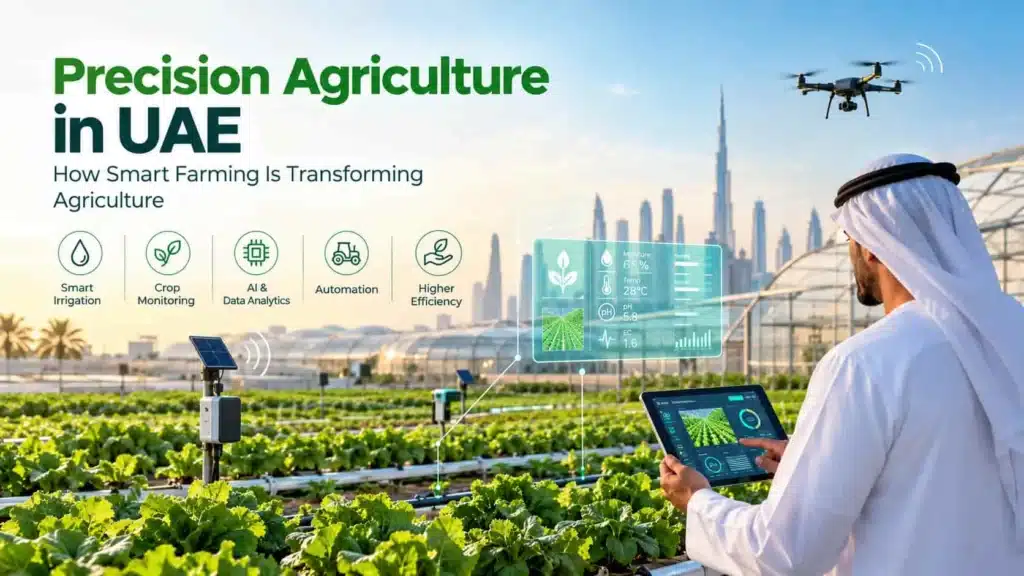
The future of agriculture in the UAE is becoming increasingly data-driven.
With limited arable land, water constraints, high temperatures, soil salinity and challenging growing conditions, UAE farmers cannot always rely on conventional farming methods to maximise productivity. Instead, modern agriculture is increasingly using sensors, automation, satellite data, artificial intelligence, smart irrigation and real-time monitoring to make farming decisions more precise.
This approach is known as precision agriculture.
Precision agriculture uses data and technology to understand what is happening across a farm and then apply the right amount of water, nutrients, crop protection and other inputs where and when they are needed.
For UAE agriculture, this is particularly relevant because the country’s environmental conditions make efficient resource management a critical part of commercial farming.
The UAE’s agricultural sector is already moving toward climate-smart and technology-enabled production, with government initiatives supporting modern agricultural technologies, sustainable production and improved resource efficiency.
But what exactly is precision agriculture, how does it work, and how can UAE farms benefit from it?
What Is Precision Agriculture?
Precision agriculture is a farming approach that uses data, sensors, connected technologies, automation and analytics to improve agricultural decision-making.
Instead of treating an entire farm as one uniform area, precision agriculture allows farmers to understand differences in:
- Soil moisture
- Temperature
- Humidity
- Crop health
- Nutrient availability
- Water requirements
- Salinity
- Irrigation performance
- Pest pressure
- Plant growth
- Yield
- Environmental conditions
Farmers can then use this information to make more targeted decisions.
For example, rather than irrigating an entire growing area according to a fixed schedule, a smart irrigation system can use sensor data and crop requirements to determine when irrigation is required.
The objective is not simply to add more technology.
The objective is to produce better agricultural outcomes using better information.
Why Precision Agriculture Matters in the UAE?
The UAE presents a very different agricultural environment from countries with abundant rainfall, large areas of fertile soil and naturally moderate temperatures.
The country’s official agriculture information identifies several challenges, including low rainfall, high temperatures, poor soil, lack of natural waterways, water-resource scarcity, soil salinity, agricultural pests and high production costs.
These conditions make resource efficiency particularly important.
Precision agriculture can help address some of these challenges by giving farmers better information about how their crops, irrigation systems and growing environments are performing.
The key areas include:
- Efficient water management
- Precise irrigation
- Better nutrient management
- Crop monitoring
- Environmental monitoring
- Early detection of problems
- Reduced input wastage
- Improved farm productivity
- Better decision-making
- Agricultural automation
This aligns closely with the UAE’s broader focus on sustainable agriculture and technology-enabled food production.
How Precision Agriculture Works?
Precision agriculture generally combines several technologies rather than relying on one piece of equipment.
A typical system may include:
Sensors → Data collection → Connectivity → Analytics → Decision-making → Automation → Monitoring
For example:
A soil-moisture sensor detects that moisture has fallen below the desired range.
The information is transmitted to a central platform.
The system analyses the reading against crop requirements.
The irrigation system then delivers the required amount of water.
The farmer can monitor the process and review the data.
This creates a continuous feedback loop.
Instead of asking:
“When should I irrigate?”
the farmer can ask:
“What does the crop data tell me about irrigation requirements right now?”
That is the fundamental difference between conventional scheduling and data-driven agriculture.
1. Smart Irrigation
Water management is one of the most important applications of precision agriculture in the UAE.
Smart irrigation systems can combine:
- Soil-moisture sensors
- Weather information
- Crop requirements
- Irrigation schedules
- Flow meters
- Pressure monitoring
- Automated valves
- Central control systems
The system can then adjust irrigation based on actual conditions rather than relying entirely on fixed schedules.
This can help reduce unnecessary irrigation and improve consistency.
However, smart irrigation does not mean simply watering less.
The objective is to provide the crop with the right amount of water at the right time.
Over-irrigation can waste water and nutrients, while under-irrigation can create plant stress and reduce crop performance.
2. Soil and Root-Zone Monitoring
Soil conditions can vary significantly across agricultural areas.
Precision agriculture allows growers to monitor important variables rather than relying entirely on visual observation.
Depending on the farming system, monitoring may include:
- Soil moisture
- Electrical conductivity
- pH
- Temperature
- Nutrient levels
- Salinity
- Root-zone conditions
For UAE farms, salinity deserves particular attention.
Poor water quality and salt accumulation can affect plant growth and nutrient availability.
Regular monitoring can help farmers identify changes before they become major crop problems.
3. Sensors and IoT in Agriculture
Internet of Things technology allows agricultural equipment and sensors to communicate with digital platforms.
Sensors can collect information about:
- Air temperature
- Relative humidity
- Soil moisture
- Light intensity
- Water flow
- Water temperature
- EC
- pH
- Greenhouse conditions
- Crop environment
The value comes from converting this data into useful information.
A sensor that collects data but is never analysed does not create much agricultural value.
The real benefit comes when the data is used to support decisions or automate processes.
4. Greenhouse Climate Monitoring
Precision agriculture becomes particularly powerful when combined with protected cultivation.
A modern greenhouse can monitor environmental conditions continuously.
Important variables may include:
- Temperature
- Humidity
- Solar radiation
- CO₂
- Ventilation
- Irrigation
- Root-zone conditions
- Light levels
When environmental conditions move outside the desired range, the system can alert the farm team or trigger automated equipment.
Depending on the greenhouse design, this can include:
- Ventilation
- Cooling
- Shading
- Irrigation
- Fertigation
- Climate-control equipment
For UAE greenhouse farming, this level of environmental monitoring can be particularly valuable because external conditions can change rapidly and summer temperatures can create significant crop stress.
5. Precision Fertigation
Fertigation combines irrigation and fertiliser application.
Instead of applying nutrients without continuously monitoring the growing environment, farmers can use information such as:
- EC
- pH
- Crop stage
- Water quality
- Irrigation volume
- Nutrient requirements
to improve nutrient management.
This is particularly useful in hydroponic and controlled-environment agriculture.
The objective is to maintain an appropriate nutrient environment while avoiding unnecessary inputs.
Precision fertigation can also help farmers identify changes in nutrient solution conditions before they result in visible crop symptoms.
6. Drones and Aerial Crop Monitoring
Drones can provide another layer of agricultural data.
Depending on the equipment and application, aerial systems can help capture information about:
- Crop growth
- Plant stress
- Field variation
- Irrigation problems
- Vegetation health
- Pest or disease indicators
- Crop development
This can be particularly useful for larger farms where manually inspecting every part of the property is difficult.
However, drone imagery should not be treated as a replacement for field inspection.
Aerial data can identify potential problems, but farmers may still need to inspect affected areas physically to determine the actual cause.
7. Satellite Data and Remote Sensing
Satellite imagery can provide farmers with information about agricultural areas without requiring physical inspection of every location.
Remote sensing can help identify differences in:
- Vegetation
- Crop growth
- Moisture conditions
- Field performance
- Plant stress
When combined with ground-level sensor data, satellite information can provide a broader view of farm performance.
For large agricultural operations, this can support more targeted field inspections and management decisions.
8. Artificial Intelligence in Precision Agriculture
Artificial intelligence can help agriculture move beyond simply collecting data.
AI systems can analyse large quantities of agricultural information and identify patterns that may be difficult to detect manually.
Potential applications include:
- Crop monitoring
- Yield prediction
- Irrigation optimisation
- Disease detection
- Pest identification
- Environmental prediction
- Crop growth analysis
- Automated decision support
The UAE has already explored the use of artificial intelligence and machine learning in agricultural research, including projects focused on improving hydroponic production and analysing growing conditions.
However, AI should be implemented around a clearly defined agricultural problem.
Adding AI to a farm without reliable data, sensors and operational processes does not automatically improve productivity.
9. Automated Farming Systems
Automation is where precision agriculture can move from monitoring to action.
A smart farm can potentially automate processes such as:
- Irrigation
- Fertigation
- Ventilation
- Greenhouse cooling
- Shading
- Nutrient dosing
- Environmental control
- Pump operation
- Alerts
- Data collection
This can reduce repetitive manual work and improve consistency.
For example, instead of a worker manually checking greenhouse temperature throughout the day, sensors can continuously monitor the environment and communicate with the climate-control system.
The farmer can then focus more on management, crop health and decision-making.
Precision Agriculture vs Traditional Farming
Precision agriculture does not necessarily mean replacing traditional farming with robots.
The difference is primarily about how agricultural decisions are made.
| Traditional Approach | Precision Agriculture |
|---|---|
| Fixed irrigation schedules | Data-driven irrigation |
| Manual monitoring | Continuous sensor monitoring |
| Field-wide assumptions | Location-specific information |
| Periodic inspection | Real-time monitoring |
| Manual adjustments | Automated adjustments |
| Historical experience | Experience + data |
| Reactive problem solving | Earlier detection and intervention |
| Standard input application | Targeted input management |
Traditional farming knowledge remains valuable.
In fact, the best precision agriculture systems combine farmer experience with reliable data.
Technology should support agricultural expertise rather than attempt to replace it completely.
Precision Agriculture and Hydroponics in the UAE
Precision agriculture and hydroponics are highly compatible.
A hydroponic system already provides a controlled environment where growers can monitor variables such as:
- Water
- Nutrients
- EC
- pH
- Temperature
- Irrigation frequency
- Crop growth
Adding sensors and automation can make the system more responsive.
For example, a hydroponic farm can monitor nutrient-solution EC and pH continuously rather than relying entirely on manual measurements.
This can be particularly useful for commercial operations where maintaining consistent growing conditions is important.
The UAE government has identified hydroponics as an agricultural technology with potential to improve water efficiency, while more recent government initiatives continue to emphasise closed-loop systems, vertical farming, AI and data-driven agriculture.
Precision Agriculture and Vertical Farming
Vertical farming takes the concept of controlled agriculture even further.
Plants are grown in stacked layers, typically within a highly controlled environment.
Because growing conditions are controlled, farmers can monitor:
- Temperature
- Humidity
- Light
- Irrigation
- Nutrients
- Air movement
- Crop growth
Automation can then control many of these variables.
Vertical farming can be particularly relevant to urban and space-constrained agricultural projects where maximising production from a limited footprint is important.
However, electricity and climate-control requirements need to be considered carefully.
High production density alone does not guarantee commercial profitability.
Precision Agriculture for Greenhouse Farming
Greenhouses provide an ideal environment for implementing precision agriculture because many variables can be measured and controlled.
A modern greenhouse may combine:
Sensors + Climate Control + Irrigation + Fertigation + Automation + Data Analytics
This creates a connected production environment.
For example:
- Sensors measure temperature and humidity.
- The control system analyses the readings.
- The system identifies that temperature is approaching the crop’s upper threshold.
- Ventilation or cooling equipment is activated.
- The farmer receives an alert or views the change through a monitoring platform.
- The system continues tracking the environment.
This type of automation can help create more consistent growing conditions.
What Are the Benefits of Precision Agriculture in UAE?
Precision agriculture can provide several potential benefits.
Better Water Management
Farmers can use data to understand crop water requirements and identify inefficient irrigation.
Improved Resource Efficiency
Inputs such as water, nutrients and energy can be monitored more closely.
Earlier Problem Detection
Sensors can identify environmental changes before problems become visually obvious.
Better Crop Monitoring
Farmers can monitor crop conditions more frequently without physically inspecting every plant.
Reduced Input Waste
More precise application can reduce unnecessary use of water, nutrients and other inputs.
Improved Farm Management
Data provides managers with information that can support production decisions.
Automation
Repetitive agricultural tasks can potentially be automated.
Better Record Keeping
Digital systems can create historical records of environmental conditions, irrigation, crop performance and farm operations.
Is Precision Agriculture Expensive?
The cost depends heavily on the size and complexity of the farm.
A small farm does not necessarily need a sophisticated AI-powered system.
A basic precision agriculture setup might include:
- Soil-moisture sensors
- Automated irrigation
- Weather monitoring
- Basic farm-management software
A large commercial operation could require:
- Extensive sensor networks
- Greenhouse automation
- Climate-control systems
- Automated fertigation
- Remote monitoring
- Drone imagery
- Data platforms
- AI-based analytics
- Integrated farm-management systems
The right approach is to start with the agricultural problem.
For example:
Problem: Excessive irrigation
Solution: Soil-moisture monitoring + smart irrigation
rather than:
Solution: Install every available agricultural technology.
Technology should have a measurable purpose.
How to Implement Precision Agriculture on a UAE Farm?
A practical implementation can be divided into several stages.
Step 1: Identify the Farm’s Main Problems
Start by identifying the biggest operational challenges.
These may include:
- Excessive water consumption
- Poor irrigation uniformity
- Crop losses
- High labour requirements
- Temperature fluctuations
- Nutrient management
- Lack of farm data
- Poor crop monitoring
Step 2: Establish Baseline Data
Before changing the production system, measure current performance.
Track:
- Water consumption
- Energy consumption
- Crop yield
- Crop losses
- Labour
- Fertiliser use
- Irrigation performance
Without baseline data, it becomes difficult to determine whether a technology has actually improved the farm.
Step 3: Select Appropriate Sensors
Choose sensors based on the problem.
A greenhouse may need environmental sensors.
A field farm may need soil-moisture monitoring.
A hydroponic operation may require EC and pH monitoring.
Avoid installing sensors simply because they are available.
Step 4: Connect the Data
Data becomes much more useful when it is available through a central monitoring platform.
Farm managers should be able to understand:
- What is happening?
- Where is it happening?
- How serious is it?
- What action is required?
Step 5: Introduce Automation
Once reliable data is available, automation can be introduced.
Examples include:
- Automated irrigation
- Automated fertigation
- Climate control
- Ventilation
- Shading
- Cooling
- Alerts
Step 6: Measure Results
After implementation, compare performance against the original baseline.
Track indicators such as:
- Water used per unit of production
- Yield per square metre
- Energy consumption
- Labour hours
- Crop losses
- Fertiliser use
- Production consistency
This is how farmers can determine whether a technology investment is actually delivering value.
Key Challenges of Precision Agriculture in the UAE
Precision agriculture has significant potential, but it also has limitations.
Initial Investment
Sensors, automation, software, communication infrastructure and control systems require capital.
Technical Expertise
Farm teams need to understand how to interpret and use the data.
Maintenance
Sensors and automated systems require calibration, maintenance and occasional replacement.
Data Quality
Poor sensor placement or inaccurate equipment can result in poor decisions.
Connectivity
Connected systems depend on reliable communication infrastructure.
Integration
Different technologies need to work together effectively.
Energy Requirements
Climate-controlled agriculture and automation can increase electricity requirements.
Human Expertise Still Matters
Technology cannot identify every agricultural problem automatically.
Experienced farm managers remain important for interpreting data and making practical decisions.
The Future of Precision Agriculture in UAE
Precision agriculture is likely to become increasingly important as UAE agriculture focuses on productivity, resource efficiency, climate resilience and technology-enabled food production.
The country’s agricultural strategy is increasingly connected with:
- Artificial intelligence
- Smart irrigation
- Hydroponics
- Vertical farming
- Controlled environments
- Agricultural automation
- Data analytics
- Climate-smart agriculture
- Modern farm management
The UAE has also established programmes aimed at increasing the adoption of climate-smart agricultural solutions. The National Agricultural Centre, for example, has stated targets related to increasing productive farms, organic farms and farms adopting climate-smart solutions.
This direction reflects a broader shift in agriculture:
From farming based primarily on observation to farming supported by continuous data.
The farmer’s experience remains important, but it is increasingly supported by sensors, software, automation and analytics.
Precision Agriculture and Food Security
Precision agriculture is not only about improving individual farm performance.
It can also contribute to broader food-security objectives.
The UAE’s National Food Security Strategy 2051 places emphasis on sustainable, technology-enabled domestic food production and increasing local production.
This creates an important role for technologies that can help farms produce more efficiently under difficult environmental conditions.
For the UAE, the challenge is not simply producing more food.
It is producing food while managing:
- Water
- Land
- Energy
- Climate
- Labour
- Production costs
- Environmental resources
Precision agriculture provides tools that can help farmers make more informed decisions across these areas.
How Skyfield Agritech Supports Precision Agriculture?
Precision agriculture works best when different agricultural technologies are designed to work together.
For a commercial UAE farm, this could involve combining:
- Controlled environment agriculture
- Hydroponic systems
- Vertical farming solutions
- Greenhouse and farming automation
- Smart irrigation
- Farm management
- Data monitoring
- Agricultural automation
The exact technology stack should depend on the crop, farm size, production method, available resources and commercial objectives.
A small farm may need only targeted irrigation automation and environmental monitoring.
A large commercial greenhouse may require an integrated system covering climate control, fertigation, irrigation, sensors, automation and farm management.
The objective should always be the same:
Use technology where it solves a real agricultural problem and creates measurable value.
Frequently Asked Questions
What is precision agriculture?
Precision agriculture is a technology-driven approach to farming that uses sensors, data, analytics, automation and monitoring to make agricultural decisions more accurately.
Why is precision agriculture important in UAE?
Precision agriculture is particularly relevant to the UAE because farms operate under challenging conditions involving water constraints, high temperatures, soil limitations and limited arable land.
How does precision agriculture save water?
Precision agriculture can improve water management by using sensor data, crop requirements and automated irrigation to deliver water more accurately and avoid unnecessary irrigation.
What technologies are used in precision agriculture?
Common technologies include sensors, IoT devices, GPS, satellite imagery, drones, smart irrigation, automation, artificial intelligence, data analytics and farm-management software.
Is precision agriculture suitable for small farms?
Yes. A farm does not need a highly complex system to benefit from precision agriculture. Smaller farms can begin with targeted technologies such as soil-moisture monitoring, automated irrigation or environmental sensors.
Can precision agriculture be used with hydroponics?
Yes. Hydroponics and precision agriculture work well together because growers can continuously monitor variables such as pH, EC, water temperature, nutrient concentration and irrigation.
What is the difference between smart farming and precision agriculture?
The terms are often used interchangeably, but precision agriculture generally focuses on using data to manage variation and optimise agricultural inputs, while smart farming can refer more broadly to connected technologies, automation, AI and digital farm-management systems.
Is precision agriculture expensive in the UAE?
The cost depends on the technology, farm size and level of automation. A targeted system can be relatively simple, while a fully automated commercial greenhouse can require significant investment.
Final Thoughts
Precision agriculture is changing how modern farms approach production.
For UAE agriculture, its importance is particularly clear because farmers must operate within challenging environmental and resource conditions.
The combination of sensors, smart irrigation, automation, artificial intelligence, data analytics, hydroponics, vertical farming and controlled environments can give farmers better visibility and control over their operations.
But successful precision agriculture is not about buying the most advanced technology.
It is about identifying the farm’s biggest challenges and using the right technology to solve them.
For a UAE farm, that might mean reducing unnecessary irrigation, improving greenhouse climate control, monitoring nutrient conditions, identifying crop stress earlier or automating repetitive operations.
The future of agriculture is not simply about growing more.
It is about growing more intelligently, using data to make better decisions and using limited resources more efficiently.

