
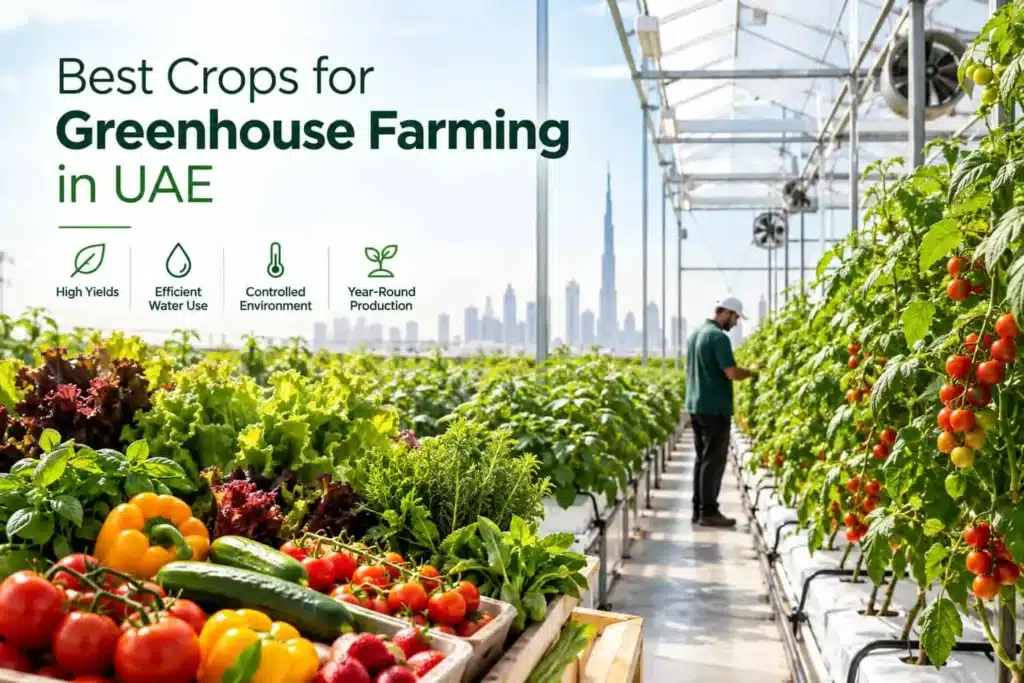
Greenhouse farming has become an important part of modern agriculture in the UAE. With high temperatures, limited water resources, soil salinity, and challenging outdoor growing conditions, protected cultivation allows farmers to create a more controlled environment for producing crops.
But not every crop is equally suitable for greenhouse farming in the UAE.
The right crop depends on several factors, including greenhouse design, cooling requirements, growing season, water availability, production system, labour requirements, crop cycle, market demand, and expected selling price.
For commercial growers, the objective should not simply be to select a crop that has a high market price. The more important question is:
Which crop can produce reliable yields and commercially viable returns within the specific greenhouse environment and UAE market?
This guide explores some of the best crops for greenhouse farming in the UAE, including vegetables, leafy greens, herbs and premium crops, while also explaining the factors farmers should consider before selecting a crop.
Why Greenhouse Farming Is Important in the UAE?
The UAE’s agricultural environment presents several challenges for conventional farming.
High temperatures, limited rainfall, water scarcity, soil salinity and limited arable land can all affect crop production.
Greenhouses provide farmers with greater control over the growing environment.
Depending on the greenhouse design, growers can manage:
- Temperature
- Humidity
- Irrigation
- Fertigation
- Ventilation
- Shading
- Crop protection
- Growing media
- Root-zone conditions
- Light exposure
This does not eliminate the UAE climate as a challenge, but it allows farmers to manage its impact more effectively.
The UAE has also been encouraging the adoption of modern agricultural technologies, including protected agriculture, hydroponics and other resource-efficient farming systems.
What Makes a Crop Suitable for Greenhouse Farming in UAE?
Before selecting a crop, commercial growers should evaluate more than market price.
Climate Compatibility
The crop should be capable of performing under the temperature and humidity conditions that can realistically be maintained inside the greenhouse.
Cooling Requirements
Some crops can tolerate higher temperatures than others.
A crop that requires intensive cooling throughout the summer may have significantly higher operating costs.
Water Requirements
Water efficiency is particularly important in the UAE.
Crops that perform well with drip irrigation, fertigation or hydroponic systems can be attractive for controlled agriculture.
Production Cycle
Shorter production cycles can allow growers to produce multiple crop cycles within a year.
However, longer-cycle crops may also be commercially attractive if their yield and selling price justify the longer production period.
Market Demand
A crop should have a clear market before commercial production begins.
Potential customers include:
- Supermarkets
- Hotels
- Restaurants
- Catering companies
- Food distributors
- Wholesale markets
- Direct consumers
Labour Requirements
Harvesting, pruning, pollination, training, grading and packaging can significantly affect production costs.
Post-Harvest Requirements
Highly perishable crops require efficient harvesting, packaging, cooling and distribution.
A greenhouse crop is only commercially successful if the farm can move the harvested product to the customer while maintaining quality.
1. Tomatoes
Tomatoes are one of the most important crops to consider for commercial greenhouse farming in the UAE.
They can be cultivated in protected environments using soil-based systems, substrate cultivation, fertigation and hydroponic systems.
Different varieties can target different market segments, including:
- Standard tomatoes
- Cherry tomatoes
- Cocktail tomatoes
- Specialty varieties
- Premium greenhouse tomatoes
Why Tomatoes Are Suitable for Greenhouse Farming?
Tomatoes can benefit significantly from controlled growing conditions.
A greenhouse can help growers manage:
- Temperature
- Irrigation
- Nutrient delivery
- Humidity
- Ventilation
- Pest pressure
- Plant training
- Root-zone conditions
Tomatoes can also be suitable for advanced fertigation and hydroponic systems.
However, commercial tomato production requires careful environmental management. High temperatures can affect flowering, fruit set and overall crop performance, making greenhouse climate management particularly important during hot periods.
2. Cucumbers
Cucumbers are another important crop for greenhouse production in the UAE.
Cucumbers can perform well under controlled conditions when temperature, humidity, irrigation and nutrition are properly managed.
Advantages of Greenhouse Cucumber Production
- Relatively fast-growing crop
- Strong consumer demand
- Suitable for protected cultivation
- Compatible with hydroponic systems
- Suitable for trellising
- Potential for repeated harvesting
- Efficient use of greenhouse space
Cucumbers can be particularly attractive for commercial growers because plants can be trained vertically, allowing more effective use of greenhouse growing space.
However, disease management and humidity control are important considerations.
Excessive humidity and poor ventilation can create favourable conditions for certain plant diseases.
3. Bell Peppers
Bell peppers are another strong candidate for greenhouse production.
Different colours and varieties can serve different market segments, including conventional and premium produce.
Greenhouse cultivation provides greater control over the growing environment and can help protect crops from some of the environmental stresses associated with outdoor production.
Why Grow Bell Peppers in a Greenhouse?
- Controlled temperatures
- Consistent irrigation
- Precise fertigation
- Protected growing conditions
- Better crop monitoring
- Improved environmental control
However, growers need to account for crop duration, plant management, pollination, nutrition and climate requirements.
The economics should be calculated over the complete crop cycle rather than based only on the selling price per kilogram.
4. Leafy Greens
Leafy greens are particularly interesting for greenhouse and controlled-environment agriculture.
Common examples include:
- Lettuce
- Spinach
- Kale
- Arugula
- Asian greens
- Mixed salad leaves
Leafy greens can also be well suited to hydroponic systems.
Why Leafy Greens Are Attractive
Many leafy greens have relatively short production cycles compared with fruiting crops.
This can allow growers to produce multiple crop cycles and respond more quickly to changes in market demand.
They can also be grown using:
- Hydroponic systems
- NFT systems
- Deep water culture
- Vertical farming
- Greenhouse systems
- Controlled-environment systems
For commercial operations, consistency is often more important than simply maximising yield.
Uniform size, appearance, freshness and reliable supply can be important factors when selling to supermarkets, restaurants and food-service businesses.
5. Basil and Other Fresh Herbs
Fresh herbs can be highly suitable for greenhouse and hydroponic production.
Potential greenhouse herbs include:
- Basil
- Mint
- Coriander
- Parsley
- Thyme
- Rosemary
- Oregano
- Chives
Why Herbs Can Work Well in Greenhouses
- Relatively small growing footprint
- Strong food-service demand
- Compatibility with hydroponics
- Multiple harvest opportunities
- Potential premium for fresh local production
However, commercial herb production should be connected to a clear sales strategy.
Restaurants, hotels and supermarkets may have specific requirements for bunch size, packaging, freshness and delivery frequency.
6. Zucchini
Zucchini is another crop that can be considered for protected agriculture in the UAE.
Greenhouse production can provide growers with greater control over irrigation, nutrition, temperature and pest management.
Zucchini can be suitable for growers looking for a crop that can be integrated into diversified vegetable production.
However, crop spacing, pollination, disease management and ventilation need to be considered when designing the greenhouse production system.
7. Strawberries
Strawberries can provide opportunities for premium greenhouse production, particularly when growers target high-value retail or hospitality markets.
The UAE climate makes environmental control especially important for strawberries.
A greenhouse or other controlled system can help create more suitable growing conditions than exposed outdoor cultivation during unsuitable periods.
Potential Advantages
- Premium product category
- Strong consumer interest
- Suitable for protected cultivation
- Can be grown using soilless systems
- Potentially high value per growing area
However, strawberries are not automatically a profitable crop simply because they command a premium price.
Growers need to consider:
- Cooling
- Humidity
- Planting material
- Pollination
- Disease management
- Labour
- Harvesting
- Packaging
- Cold-chain requirements
The economics should be calculated before investment.
8. Microgreens
Microgreens are a niche crop that can be particularly suitable for highly controlled production environments.
Examples include:
- Radish microgreens
- Broccoli
- Sunflower
- Pea shoots
- Mustard
- Basil
- Coriander
They can be produced in relatively small spaces and have short production cycles.
Why Microgreens Can Be Attractive
Microgreens can target:
- Restaurants
- Hotels
- Premium retailers
- Catering businesses
- Health-focused consumers
- Direct-to-consumer markets
Their short production cycle can make them attractive for businesses capable of selling directly into premium markets.
However, market demand should be established before scaling production.
Microgreens are highly perishable, and a farm can face significant losses if production exceeds sales.
9. Specialty Tomatoes
Specialty tomatoes deserve separate consideration from conventional tomato production.
Examples include:
- Cherry tomatoes
- Cocktail tomatoes
- Premium coloured varieties
- Gourmet tomato varieties
These crops can target consumers and businesses looking for differentiated produce rather than commodity vegetables.
Potential Advantages of Specialty Tomatoes
- Product differentiation
- Premium market positioning
- Potential for higher-value sales
- Suitable for controlled production
However, specialty crops generally require a clearly defined target market.
Best Greenhouse Crops in UAE at a Glance
| Crop | Greenhouse Suitability | Potential Market | Important Considerations |
|---|---|---|---|
| Tomatoes | High | Retail, restaurants, distributors | Climate control, fertigation, crop training |
| Cucumbers | High | Retail, wholesale, food service | Humidity, ventilation, irrigation |
| Bell peppers | High | Retail, wholesale | Crop cycle, temperature, nutrition |
| Lettuce | High | Retail, restaurants, food service | Temperature, freshness, crop turnover |
| Spinach | High | Retail, food service | Temperature and crop quality |
| Kale | High | Retail, health-focused markets | Climate and market demand |
| Basil | High | Restaurants, retail | Freshness and harvesting |
| Mint | High | Food service, retail | Moisture and harvest management |
| Coriander | High | Retail, restaurants | Temperature and freshness |
| Parsley | High | Retail, food service | Crop quality and market |
| Zucchini | Moderate to high | Retail, wholesale | Pollination, spacing, ventilation |
| Strawberries | Premium potential | Retail, hospitality | Cooling, labour, post-harvest |
| Microgreens | Niche/high-value | Restaurants, premium markets | Sales channels and shelf life |
Which Greenhouse Crops Are Best for UAE Summers?
Summer is one of the biggest considerations when selecting crops for UAE greenhouse farming.
Outdoor temperatures can become extremely challenging for many vegetable crops.
A greenhouse does not automatically solve the problem.
During hot periods, growers may need to use:
- Cooling systems
- Shade screens
- Ventilation
- Evaporative cooling
- Climate monitoring
- Automated irrigation
- Humidity management
The crop should therefore be selected together with the greenhouse’s climate-control capabilities.
A crop that performs well in the UAE during cooler months may require significantly more energy and infrastructure during summer.
This is one reason commercial growers should evaluate crop profitability on an annual production basis, rather than looking at one season in isolation.
Greenhouse Crops vs Hydroponic Crops
Many greenhouse crops can also be grown hydroponically.
Hydroponics can provide greater control over the root-zone environment and nutrient delivery while reducing dependence on agricultural soil.
Suitable greenhouse hydroponic crops can include:
- Tomatoes
- Cucumbers
- Bell peppers
- Lettuce
- Basil
- Mint
- Coriander
- Strawberries
However, hydroponics introduces additional technical requirements.
Growers need to manage:
- Water quality
- pH
- EC
- Nutrient concentration
- Irrigation frequency
- Root-zone temperature
- System sanitation
Hydroponic systems therefore work best when they are properly designed and managed rather than simply installed as an alternative to soil.
How to Choose the Right Greenhouse Crop
1. Identify Your Market
Before selecting a crop, identify potential customers.
Ask:
- Who will buy the produce?
- How much do they need?
- What quality do they expect?
- What packaging do they require?
- How frequently do they need deliveries?
- What price range can the market support?
2. Study the Production Cycle
Compare crops based on their complete production cycle.
Consider:
- Nursery period
- Transplanting
- Vegetative growth
- Flowering
- Fruit development
- Harvest period
- Crop removal
- Greenhouse preparation for the next cycle
3. Calculate Water Requirements
Water availability and efficiency are fundamental considerations in UAE agriculture.
A crop requiring significant irrigation may need a different production system from a crop that can be produced efficiently through controlled irrigation or hydroponics.
4. Calculate Cooling Requirements
Do not ignore summer energy costs.
For some crops, maintaining suitable conditions can require significant cooling and ventilation.
The crop’s economic model should therefore include expected energy consumption.
5. Consider Labour
A crop requiring extensive pruning, training, harvesting or grading may require considerably more labour.
Labour should be calculated as part of the crop’s total production cost.
6. Evaluate Selling Price and Yield Together
Selling price alone is not enough.
A better commercial assessment considers:
Revenue = Yield × Selling Price
Then subtract:
- Seeds or seedlings
- Water
- Fertilisers
- Energy
- Labour
- Packaging
- Transportation
- Maintenance
- Crop protection
- Greenhouse depreciation
- Other operating expenses
This provides a more realistic view of profitability.
Can Greenhouse Farming Be Profitable in UAE?
Greenhouse farming can offer strong commercial opportunities in the UAE, but profitability depends on the complete production model.
Factors include:
- Crop selection
- Greenhouse design
- Climate control
- Water efficiency
- Yield
- Selling price
- Crop cycle
- Energy costs
- Labour
- Market access
- Post-harvest handling
A high-value crop can still be unprofitable if it requires excessive cooling or labour.
Similarly, a crop with a lower selling price can potentially be commercially attractive if it has reliable demand, high turnover and efficient production.
The most important principle is:
Do not select the crop first and design the farm around it. Evaluate the crop, market and production system together.
Role of Greenhouse Automation in UAE
Automation can help commercial greenhouse operators manage environmental conditions more consistently.
Modern greenhouse systems can integrate:
- Irrigation
- Fertigation
- Ventilation
- Cooling
- Shading
- Temperature monitoring
- Humidity monitoring
- Environmental sensors
- Automated controls
For example, a greenhouse climate-control system can monitor temperature and humidity and trigger equipment when conditions move outside predefined parameters.
This can reduce the dependence on manual monitoring and help maintain more consistent growing conditions.
Automation is particularly valuable when a farm needs to manage production continuously throughout the year.
Why Climate Control Matters
Greenhouse farming in the UAE is not simply about putting a roof over the crops.
The greenhouse must create an environment in which the selected crop can perform economically.
Depending on the crop and greenhouse design, climate management may involve:
- Natural ventilation
- Mechanical ventilation
- Evaporative cooling
- Shade systems
- Heating during cooler periods
- Humidity management
- Irrigation control
- Environmental sensors
The required system depends on the crop.
A greenhouse designed for leafy greens may have different requirements from one designed for tomatoes or strawberries.
Greenhouse Crop Selection and Water Efficiency
Water efficiency should be considered from the beginning of the greenhouse design process.
The UAE’s agricultural policies place significant emphasis on efficient water use and modern agricultural systems.
Greenhouse production can incorporate technologies such as:
- Drip irrigation
- Fertigation
- Automated irrigation
- Water monitoring
- Recirculating systems
- Hydroponics
- Sensors
The goal is not simply to use less water.
It is to use water more efficiently while maintaining crop productivity and quality.
Common Mistakes When Choosing Greenhouse Crops
Choosing a Crop Because It Has a High Selling Price
A high price does not necessarily mean a high profit.
Production costs matter.
Ignoring Summer Conditions
A crop that performs well in winter may become expensive to produce during summer.
Choosing Technology Before Choosing the Production Objective
Technology should solve a real production problem.
Ignoring the Market
Growing a crop without reliable buyers creates significant commercial risk.
Underestimating Labour
Harvesting, pruning and packaging can require substantial labour.
Ignoring Post-Harvest Handling
Fresh produce must reach customers quickly and in good condition.
Using the Same Greenhouse Design for Every Crop
Different crops have different environmental requirements.
Best Greenhouse Crops for Different Business Models
For Large Commercial Greenhouses
Consider:
- Tomatoes
- Cucumbers
- Bell peppers
- Zucchini
These crops can be suitable for larger-scale protected vegetable production when market demand and production economics support them.
For Hydroponic Greenhouses
Consider:
- Lettuce
- Basil
- Mint
- Coriander
- Tomatoes
- Cucumbers
- Strawberries
For Premium Markets
Consider:
- Cherry tomatoes
- Specialty tomatoes
- Strawberries
- Microgreens
- Premium herbs
- Specialty salad greens
For Short Crop Cycles
Consider:
- Lettuce
- Microgreens
- Basil
- Coriander
- Other leafy greens
The correct choice depends on the farm’s infrastructure and market rather than a universal ranking of crops.
The Future of Greenhouse Farming in UAE
The UAE is increasingly focused on sustainable and technology-enabled agricultural production.
Modern greenhouse operations are moving beyond simple protected structures toward integrated production environments combining:
- Climate control
- Smart irrigation
- Hydroponics
- Sensors
- Automation
- Data analytics
- Farm management
- Artificial intelligence
This development is consistent with the country’s broader food-security and sustainable agriculture objectives.
For commercial growers, this means greenhouse design and crop selection increasingly need to be considered together with technology, resource efficiency and market requirements.
The greenhouse of the future is not simply a structure that protects plants from the weather.
It is a controlled production system designed around the crop.
How Skyfield Agritech Can Help?
Selecting the right crop is only the beginning of a successful greenhouse project.
The production system must be designed around the crop’s environmental requirements, available resources and commercial objectives.
Skyfield Agritech provides solutions for modern agricultural operations, including:
- Turnkey greenhouse systems
- Custom hydroponic systems
- Controlled environment agriculture
- Vertical farming solutions
- Greenhouse and farming automation
- Farm management solutions
A commercial greenhouse project can be designed around factors such as crop selection, growing method, climate requirements, irrigation, fertigation, automation, farm size and expected production.
The objective is to create a system that is technically appropriate for the crop and commercially practical for the grower.
Frequently Asked Questions
What are the best crops for greenhouse farming in UAE?
Tomatoes, cucumbers, bell peppers, lettuce, spinach, kale, herbs and zucchini are among the crops that can be suitable for greenhouse cultivation in the UAE. Strawberries, microgreens and specialty crops can also be considered for specific premium markets.
Which greenhouse crop is most profitable in UAE?
There is no universally most profitable greenhouse crop. Profitability depends on yield, selling price, crop cycle, cooling requirements, labour, water, energy, infrastructure and market demand.
What vegetables grow well in UAE greenhouses?
Tomatoes, cucumbers, bell peppers, zucchini and leafy vegetables can be suitable for protected cultivation. The exact crop selection should depend on the greenhouse environment and production season.
Can tomatoes be grown in greenhouses in UAE?
Yes. Tomatoes are suitable for protected cultivation and can be produced using greenhouse, fertigation, substrate and hydroponic systems. Temperature and environmental management are particularly important during hot periods.
Can cucumbers be grown hydroponically in UAE?
Yes. Cucumbers can be produced using hydroponic systems, including greenhouse-based systems. Irrigation, nutrient management, temperature, humidity and ventilation need to be carefully controlled.
Which herbs are suitable for greenhouse farming in UAE?
Basil, mint, coriander, parsley, thyme, rosemary, oregano and chives can be considered for greenhouse production, depending on market demand and environmental conditions.
Are leafy greens suitable for greenhouse farming in UAE?
Yes. Lettuce, spinach, kale, arugula and other leafy greens can be suitable for greenhouse and controlled-environment production.
Can strawberries be grown in UAE greenhouses?
Yes, strawberries can be grown under controlled conditions, but they require careful management of temperature, humidity, irrigation, nutrition, pollination and post-harvest handling.
Is greenhouse farming better than open-field farming in UAE?
Greenhouse farming provides greater control over environmental conditions and can extend the production window for certain crops. However, it also involves additional capital and operating costs, particularly for cooling and automation.
What should I consider before starting a greenhouse farm in UAE?
Consider your target market, crop, greenhouse design, climate-control requirements, water quality, irrigation system, production cycle, labour, energy consumption, automation requirements and expected operating costs before investing.
Conclusion
The UAE’s climate creates challenges for agricultural production, but greenhouse farming provides growers with an opportunity to create a more controlled environment for crop production.
Tomatoes, cucumbers, bell peppers, leafy greens, herbs and zucchini can be strong candidates for greenhouse cultivation, while strawberries, microgreens and specialty crops can provide opportunities for more specialised markets.
However, there is no single crop that is automatically the best choice for every farm.
The right crop depends on the relationship between climate, greenhouse design, water, technology, production costs, crop cycle and market demand.
For UAE growers, the most effective approach is to design the production system around the crop rather than choosing a greenhouse technology in isolation.
When crop selection, climate control, irrigation, fertigation, automation and market strategy work together, greenhouse farming can become a more efficient and commercially viable approach to modern UAE agriculture.

