
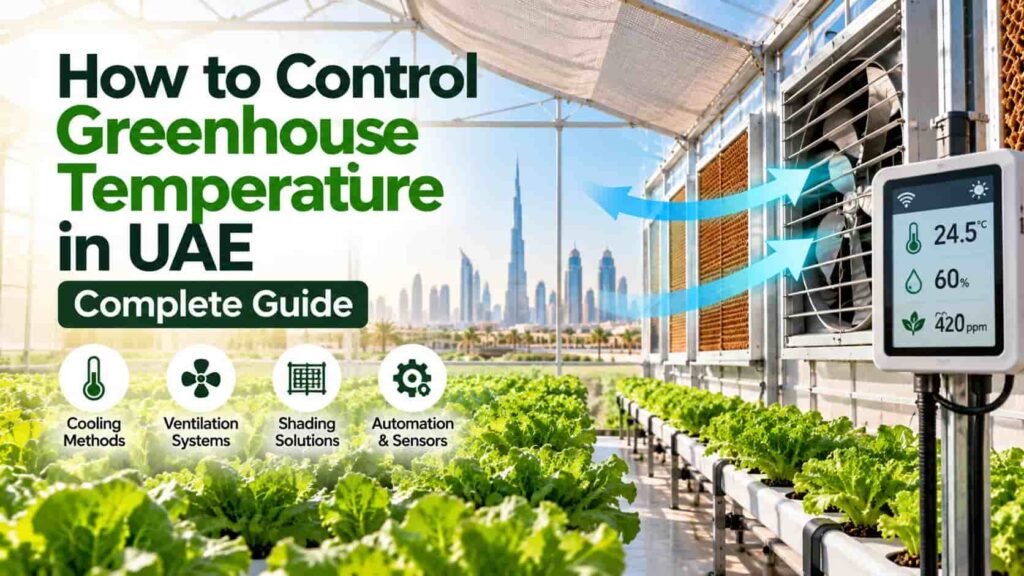
How can greenhouse temperature be controlled in the UAE?
Greenhouse temperature in the UAE can be controlled through a combination of ventilation, evaporative cooling, shade screens, cooling pads, fans, climate sensors, automated controls and proper greenhouse design. Because UAE greenhouses face intense solar radiation and high outdoor temperatures, effective climate control requires more than simply increasing ventilation. The right system depends on the crop, greenhouse structure, season, production method and level of environmental control required.
Greenhouse farming allows growers to create a more controlled environment for crops, but maintaining suitable temperatures in the UAE can be challenging.
High solar radiation, hot summer temperatures and low humidity during certain periods can quickly increase the temperature inside a greenhouse. Excessive heat can affect photosynthesis, flowering, fruit set, plant growth, water consumption and overall crop quality.
For commercial growers, greenhouse temperature management should therefore be considered as part of the complete climate-control strategy rather than as an isolated cooling problem.
This guide explains how greenhouse temperature can be controlled in the UAE, which cooling methods are commonly used, how automation improves temperature management, and what factors growers should consider when designing a greenhouse for UAE conditions.
Why Greenhouse Temperature Control Is Important in the UAE?
A greenhouse is designed to modify the growing environment, but it can also trap heat.
When sunlight enters through the greenhouse covering, radiation is converted into heat inside the structure. If this heat is not removed efficiently, the internal temperature can rise significantly above the outdoor temperature.
For UAE growers, this becomes particularly important during the hotter months.
Excessive greenhouse temperatures can lead to:
- Heat stress
- Reduced photosynthesis
- Poor flowering and fruit development
- Flower and fruit abortion
- Reduced crop quality
- Increased plant water requirements
- Faster moisture loss
- Nutrient imbalance
- Increased pest pressure
- Lower productivity
Temperature control is especially important for crops such as tomatoes, cucumbers, peppers, strawberries and leafy vegetables because each crop has its own preferred temperature range.
The goal is not simply to make the greenhouse as cold as possible. The objective is to maintain a suitable environment for the crop while using energy and water efficiently.
What Causes Greenhouses to Overheat in the UAE?
Several factors contribute to greenhouse overheating.
High Solar Radiation
The UAE receives intense sunlight for much of the year. Solar radiation entering the greenhouse can rapidly increase the temperature of the internal environment.
The greenhouse covering is essential for transmitting sufficient light to crops, but excessive radiation can also create a substantial cooling requirement.
High Outdoor Temperatures
During the UAE summer, outdoor temperatures can become extremely high. Natural ventilation may therefore become less effective because the air entering the greenhouse is already hot.
Poor Ventilation Design
Insufficient roof vents, side openings or airflow pathways can prevent hot air from leaving the structure.
Hot air naturally rises, making roof ventilation particularly important in greenhouse design.
Incorrect Greenhouse Orientation and Design
Greenhouse orientation, covering material, structure height, ventilation area and internal layout can all influence temperature management.
A greenhouse designed for a cooler climate may require significant modifications before it is suitable for UAE conditions.
Excessive Humidity
Cooling methods that use water can increase humidity. If humidity becomes too high, the greenhouse may experience condensation and a more favourable environment for certain plant diseases.
Effective climate control therefore requires managing both temperature and humidity.
What Is the Ideal Greenhouse Temperature in the UAE?
There is no single ideal temperature for every greenhouse crop.
Different crops have different temperature requirements during germination, vegetative growth, flowering and fruit production.
For example, leafy greens generally prefer cooler conditions than warm-season fruiting crops. Tomatoes, cucumbers and peppers can tolerate warmer conditions but still require protection from excessive heat.
Growers should therefore establish target temperature ranges based on:
- Crop type
- Crop growth stage
- Day temperature
- Night temperature
- Relative humidity
- Solar radiation
- CO₂ concentration
- Growing medium
- Irrigation method
Instead of setting one temperature for the entire production cycle, commercial growers can use crop-specific climate strategies.
Best Ways to Control Greenhouse Temperature in UAE
A reliable greenhouse cooling strategy usually combines several technologies rather than relying on a single method.
1. Natural Ventilation
Natural ventilation is one of the simplest ways to remove excess heat from a greenhouse.
Roof vents and side vents allow hot air to escape while bringing in cooler outside air when environmental conditions permit.
Because hot air rises, high-level roof ventilation can be particularly useful.
However, natural ventilation has limitations in the UAE.
When outdoor temperatures are already extremely high, bringing outside air into the greenhouse may not provide sufficient cooling.
Natural ventilation should therefore often be combined with mechanical or evaporative cooling systems for commercial production.
2. Mechanical Ventilation
Mechanical ventilation uses fans to move air through the greenhouse.
Exhaust fans can remove hot air while creating airflow through the growing area.
A properly designed system can help:
- Remove accumulated heat
- Improve air circulation
- Reduce stagnant air
- Manage humidity
- Improve crop microclimate
Fan capacity should be selected according to greenhouse volume, crop requirements, ventilation design and local environmental conditions.
Simply installing more fans does not automatically guarantee effective cooling. Airflow must be designed so that the entire greenhouse receives adequate air movement.
3. Evaporative Cooling
Evaporative cooling is widely used in hot climates because evaporation removes heat from the air.
One common configuration is a fan-and-pad cooling system.
In this system, water is distributed across specially designed cooling pads while fans draw air through the pads. As water evaporates, heat is removed from the incoming air.
The cooled air then moves through the greenhouse.
Evaporative cooling can be particularly useful when outdoor temperatures are high, although its effectiveness depends on humidity.
4. Fan and Pad Cooling Systems
Fan-and-pad systems are commonly used for controlled greenhouse environments.
The basic process is:
- Air enters through the wet cooling pads.
- Water evaporates from the pad surface.
- Heat is removed from the incoming air.
- Fans move the cooled air through the greenhouse.
- Warm air exits through the exhaust system.
The system should be properly sized according to the greenhouse dimensions and required airflow.
Water quality also matters because mineral deposits can reduce cooling-pad performance and increase maintenance requirements.
5. Shade Screens
Shade screens reduce the amount of solar radiation entering the greenhouse.
They can be installed internally or externally depending on the greenhouse design and climate-control strategy.
Shade screens can help:
- Reduce solar heat gain
- Protect crops from excessive radiation
- Lower cooling demand
- Reduce plant heat stress
- Manage light levels
However, excessive shading can reduce the amount of light available for photosynthesis.
The objective is therefore to balance temperature reduction with the crop’s light requirements.
Modern greenhouse systems can use automated shade screens that adjust according to radiation levels, temperature and crop requirements.
6. Greenhouse Roof Coatings and Shading Materials
Specialised greenhouse coatings and shading materials can reduce solar heat entering the structure.
Some systems are designed to reflect or diffuse a portion of incoming radiation.
This can help reduce peak temperatures while maintaining a suitable light environment for crops.
The choice of covering or coating should consider:
- Light transmission
- Diffusion
- Solar heat gain
- UV transmission
- Crop requirements
- Durability
- Cleaning requirements
7. Greenhouse Fogging and Misting
Fogging systems introduce very fine water droplets into the greenhouse environment.
As the droplets evaporate, they can reduce air temperature while increasing relative humidity.
Fogging can be useful when properly controlled, particularly in systems designed for precise environmental management.
However, excessive humidity can create other problems.
For this reason, fogging should be integrated with ventilation, humidity sensors and automated controls rather than operated continuously without feedback.
8. Evaporative Cooling Walls
Evaporative cooling walls work on the same basic principle as other evaporative cooling systems.
Air passes through a wetted surface, allowing evaporation to remove heat.
These systems can be highly effective when designed correctly, but performance depends on:
- Outdoor temperature
- Relative humidity
- Airflow
- Pad efficiency
- Water quality
- Maintenance
Regular cleaning and inspection are essential to maintain airflow and cooling performance.
9. Greenhouse Ventilation Design
Cooling equipment cannot compensate for poor greenhouse design indefinitely.
The structure itself should be designed to support heat removal.
Important design considerations include:
- Greenhouse height
- Roof ventilation
- Side ventilation
- Vent opening area
- Airflow direction
- Fan location
- Cooling-pad location
- Internal crop arrangement
- Greenhouse orientation
- Covering material
A taller greenhouse can provide a larger air volume and greater separation between the crop canopy and the hottest air near the roof.
10. Climate Sensors
Sensors provide the data required to make temperature-control decisions.
A modern greenhouse may use sensors to monitor:
- Air temperature
- Relative humidity
- Solar radiation
- CO₂
- Leaf temperature
- Root-zone temperature
- Growing-medium moisture
- Water temperature
Sensor placement is important.
A sensor installed close to a fan, cooling pad or greenhouse wall may not accurately represent the conditions experienced by the crop.
Commercial systems should therefore use appropriately positioned sensors throughout the growing environment.
11. Automated Greenhouse Climate Control
Automation can significantly improve greenhouse temperature management.
Instead of relying on workers to manually switch equipment on and off, an automated climate-control system can respond to real-time environmental data.
For example, when temperature rises above a predefined threshold, the system can automatically:
- Open ventilation vents
- Activate exhaust fans
- Deploy shade screens
- Start cooling systems
- Adjust fogging
- Modify irrigation
- Send alerts to farm operators
This creates a more responsive growing environment.
Automation can also reduce unnecessary equipment operation because systems can be controlled according to actual environmental conditions.
How Greenhouse Automation Helps Control Temperature?
A modern greenhouse can operate as an interconnected climate-management system.
Sensors collect environmental data and send it to a controller. The controller compares the measured conditions with predefined targets and activates the appropriate equipment.
For example:
Temperature increases → sensor detects change → controller responds → ventilation/cooling activates → temperature moves toward target range.
This feedback loop allows greenhouse operators to manage environmental conditions more consistently.
It can also provide historical data that helps farmers identify recurring problems and improve future crop cycles.
How to Control Greenhouse Temperature During UAE Summer?
Summer requires a more intensive cooling strategy than the cooler months.
A commercial summer greenhouse may require a combination of:
- External shading
- Evaporative cooling
- Exhaust fans
- Roof ventilation
- Side ventilation
- Fogging
- Automated climate controls
- Temperature and humidity sensors
Crop selection is also important.
Some crops may not be economically suitable for uncooled greenhouse production during extreme summer conditions.
Growers should evaluate whether cooling costs, water consumption and expected production justify maintaining the crop throughout the hottest period.
How to Reduce Greenhouse Heat Without Excessive Energy Use?
Cooling a greenhouse continuously can increase operating costs.
The goal should therefore be to reduce heat gain before relying heavily on mechanical cooling.
Strategies include:
Reduce Excess Solar Radiation
Use appropriate shading systems and greenhouse coverings to prevent unnecessary solar heat from entering the structure.
Improve Ventilation
Ensure that hot air can escape efficiently and that airflow reaches the crop canopy.
Automate Cooling
Use sensors and controllers to activate equipment according to actual conditions rather than running systems continuously.
Improve Greenhouse Insulation Where Appropriate
Depending on the greenhouse design and operating period, suitable materials can help reduce unwanted heat transfer.
Use Crop-Appropriate Climate Targets
Avoid cooling the entire greenhouse beyond what the crop actually requires.
Temperature Management in Hydroponic Greenhouses
Temperature management becomes even more important in hydroponic production because the crop environment is closely controlled.
In addition to air temperature, growers should consider:
- Nutrient solution temperature
- Root-zone temperature
- Electrical conductivity
- pH
- Dissolved oxygen
- Humidity
- Air movement
Excessive nutrient solution temperatures can affect root-zone conditions and plant performance.
For commercial hydroponic farms, climate control should therefore be integrated with irrigation and fertigation management.
Greenhouse Temperature Control and Irrigation
Temperature and irrigation are closely connected.
As temperature and solar radiation increase, crop water demand can also increase.
A greenhouse irrigation system should respond to crop demand rather than relying entirely on fixed irrigation schedules.
Sensors and automated irrigation can help growers manage water application more accurately.
This is particularly important in the UAE, where efficient water management is a major consideration for agricultural production.
How Greenhouse Temperature Affects Crop Yield?
Temperature influences several biological processes within plants.
When temperatures remain within the crop’s suitable range, plants can generally maintain better physiological activity.
Excessive heat can interfere with:
- Photosynthesis
- Flowering
- Pollination
- Fruit setting
- Nutrient uptake
- Transpiration
- Root development
The effect varies by crop and growth stage.
For commercial growers, temperature monitoring should therefore be combined with crop observations and production data.
Common Greenhouse Temperature-Control Mistakes
Using Only Fans for Summer Cooling
Fans improve air movement but cannot always provide sufficient cooling when outside temperatures are extremely high.
Excessive Shading
Too much shade can reduce photosynthetically active radiation and affect crop productivity.
Ignoring Humidity
Reducing temperature without managing humidity can create a different set of crop-management problems.
Poor Sensor Placement
A poorly positioned sensor may provide misleading data and cause automated systems to respond incorrectly.
Running Cooling Systems Continuously
Continuous operation can increase energy and water consumption unnecessarily.
Ignoring Water Quality
Evaporative cooling systems require water, and poor-quality water can contribute to scaling and maintenance problems.
Designing a Greenhouse Without Considering the Local Climate
A greenhouse designed for a temperate climate may not perform efficiently in UAE summer conditions without appropriate modifications.
Greenhouse Temperature Control for Different Crops
Different crops require different environmental strategies.
Leafy Greens
Lettuce, spinach and other leafy greens generally require greater protection from excessive heat.
Cooling, shading and controlled environments can help maintain suitable growing conditions.
Tomatoes
Tomatoes can tolerate warmer conditions than many leafy greens, but excessive heat can affect flowering and fruit setting.
Temperature, humidity, ventilation and pollination conditions should therefore be managed together.
Cucumbers
Cucumbers grow actively under warm conditions but can experience stress when temperatures become excessive.
Good ventilation and consistent irrigation are particularly important.
Bell Peppers
Peppers can perform well under controlled greenhouse conditions but require protection from excessive heat during critical growth and reproductive stages.
Strawberries
Strawberries are more sensitive to high temperatures and may benefit from carefully controlled greenhouse environments, particularly when growers are targeting premium production.
How to Design a Greenhouse for UAE Climate?
Temperature management should begin before the greenhouse is constructed.
A UAE greenhouse design should consider:
- Local climate
- Crop selection
- Production season
- Greenhouse orientation
- Structure height
- Covering material
- Ventilation
- Cooling system
- Shade system
- Irrigation
- Water availability
- Automation
- Energy requirements
- Maintenance
The best greenhouse solution is therefore not necessarily the one with the most equipment.
It is the system that creates the required crop environment while balancing productivity, water use, energy consumption and operating costs.
Greenhouse Temperature Control: Natural vs Automated Systems
| Feature | Natural Control | Automated Control |
|---|---|---|
| Ventilation | Manual or passive | Sensor-controlled |
| Temperature monitoring | Manual | Continuous |
| Shade management | Manual | Automated |
| Cooling activation | Manual | Automatic |
| Data collection | Limited | Continuous |
| Response time | Slower | Faster |
| Labour requirement | Higher | Lower |
| Precision | Variable | Higher |
Natural ventilation and manual management can work for smaller or simpler operations.
For commercial farms, automation can provide greater consistency and more precise environmental management.
Is Greenhouse Cooling Expensive in the UAE?
The cost depends on the size and design of the greenhouse and the level of environmental control required.
Major cost factors include:
- Greenhouse size
- Crop type
- Cooling capacity
- Fan requirements
- Cooling pads
- Shade systems
- Sensors
- Automation
- Water availability
- Electricity costs
- Maintenance
- Greenhouse covering
- Production season
A basic greenhouse with natural ventilation will have different cooling requirements from a fully automated commercial greenhouse producing temperature-sensitive crops throughout the year.
Instead of focusing only on the initial equipment cost, growers should evaluate the total operating cost and expected crop value.
How to Choose the Right Greenhouse Cooling System?
Before selecting a cooling system, consider:
- What crops will be grown?
- Will production continue during UAE summer?
- What greenhouse size is required?
- What temperature range must be maintained?
- What is the local humidity level?
- What water quality is available?
- What electricity capacity is available?
- How much automation is required?
- What level of labour is available?
- What is the expected return on investment?
A greenhouse consultant or system designer can use these factors to determine the appropriate combination of ventilation, shading, evaporative cooling and automation.
The Role of Controlled Environment Agriculture in UAE Greenhouses
Controlled environment agriculture provides growers with greater control over the conditions surrounding the crop.
Instead of relying primarily on external weather conditions, growers can use sensors, automation and environmental systems to regulate important parameters.
These may include:
- Temperature
- Humidity
- Light
- Irrigation
- Nutrient delivery
- CO₂
- Air movement
For UAE agriculture, this approach can be particularly valuable when producing crops that are sensitive to extreme environmental conditions.
Future of Greenhouse Temperature Control in the UAE
Greenhouse climate management is increasingly moving toward automated and data-driven systems.
Future greenhouse systems are likely to make greater use of:
- IoT sensors
- Artificial intelligence
- Predictive climate control
- Automated shading
- Smart ventilation
- Advanced fertigation
- Remote monitoring
- Digital farm-management platforms
- Real-time crop monitoring
Rather than reacting after a greenhouse becomes too hot, predictive systems can use environmental data to anticipate changes and adjust equipment before conditions reach damaging levels.
How Skyfield Agritech Can Help With Greenhouse Climate Control?
Designing an efficient greenhouse for UAE conditions requires more than selecting a structure.
The greenhouse, cooling system, ventilation, irrigation, automation and crop requirements need to work together.
Skyfield Agritech can support agricultural projects with solutions covering greenhouse systems, automation, controlled environment agriculture, hydroponics and farm management.
For commercial growers, the objective should be to create a production environment that supports crop performance while managing water, energy and operational requirements.
Frequently Asked Questions
How do you keep a greenhouse cool in the UAE?
Greenhouses in the UAE can be cooled using ventilation, exhaust fans, evaporative cooling, cooling pads, shade screens, fogging systems and automated climate-control systems. The appropriate combination depends on the crop, greenhouse design and season.
How hot can a greenhouse get in the UAE?
A greenhouse can become significantly hotter than the surrounding outdoor environment when solar radiation enters the structure and heat is not removed effectively. The actual internal temperature depends on greenhouse design, ventilation, shading, humidity and cooling systems.
What is the best cooling system for a greenhouse in UAE?
There is no single cooling system that is best for every greenhouse. Commercial greenhouses commonly combine ventilation, shading and evaporative cooling with automated temperature monitoring.
Can greenhouses operate during UAE summer?
Yes, greenhouses can operate during the UAE summer, but temperature-sensitive crops may require substantial cooling, shading, ventilation and environmental control. The economic feasibility depends on the crop and production system.
Does greenhouse shading reduce temperature?
Yes. Shading can reduce the amount of solar radiation entering the greenhouse and therefore reduce heat gain. However, excessive shading can also reduce the light available for photosynthesis.
Is evaporative cooling suitable for UAE greenhouses?
Evaporative cooling can be effective in hot climates, but its performance depends on humidity and system design. Water quality, airflow and maintenance also influence system performance.
How does automation help greenhouse temperature control?
Automation uses sensors and controllers to monitor environmental conditions and activate equipment such as fans, vents, cooling systems and shade screens according to predefined targets.
Can hydroponic greenhouses be used in the UAE?
Yes. Hydroponic greenhouse systems can be used in the UAE and can provide controlled production environments. However, successful operation requires careful management of temperature, humidity, nutrient solution, irrigation and root-zone conditions.
Final Thoughts
Greenhouse temperature control is one of the most important considerations for commercial farming in the UAE.
The country’s hot climate means that greenhouse design must account for solar radiation, high outdoor temperatures, ventilation, humidity and water availability from the beginning.
Effective temperature management usually combines several approaches rather than relying on one technology.
Ventilation removes hot air, shading reduces solar heat gain, evaporative cooling lowers incoming air temperature, sensors provide real-time information and automation allows the entire system to respond to changing conditions.
For commercial growers, the most effective strategy is to design the greenhouse around the crop, production season and business objectives rather than simply adding cooling equipment after construction.
A properly designed climate-control system can help create a more stable growing environment and provide growers with greater control over production in the challenging UAE climate.

